
US Customs Clearance for Sodium Hyaluronate: A 4,733 kg Case
For US importers of sodium hyaluronate raw material, the expensive delays usually come from the documentation chain, not from the molecule itself. In a documented US shipment, 4,733 kg of hyaluronic acid raw material, product 5243, reached a natural cosmetic and health supplement importer without a clearance hold because the avian-origin material carried complete official veterinary heat treatment certification, met US APHIS import standards, and was supported by a valid USDA import permit.
Shandong Habier Biopharma Co.,LTD is a China-based manufacturer and supplier of sodium hyaluronate and chondroitin sulfate, founded in 2015 in Qufu City, Shandong Province. Its sodium hyaluronate range covers food grade, cosmetic grade, pharma grade, high molecular weight grade, and low molecular weight grade. The US case is useful because it shows the clearance file as a working system, not as a pile of certificates.
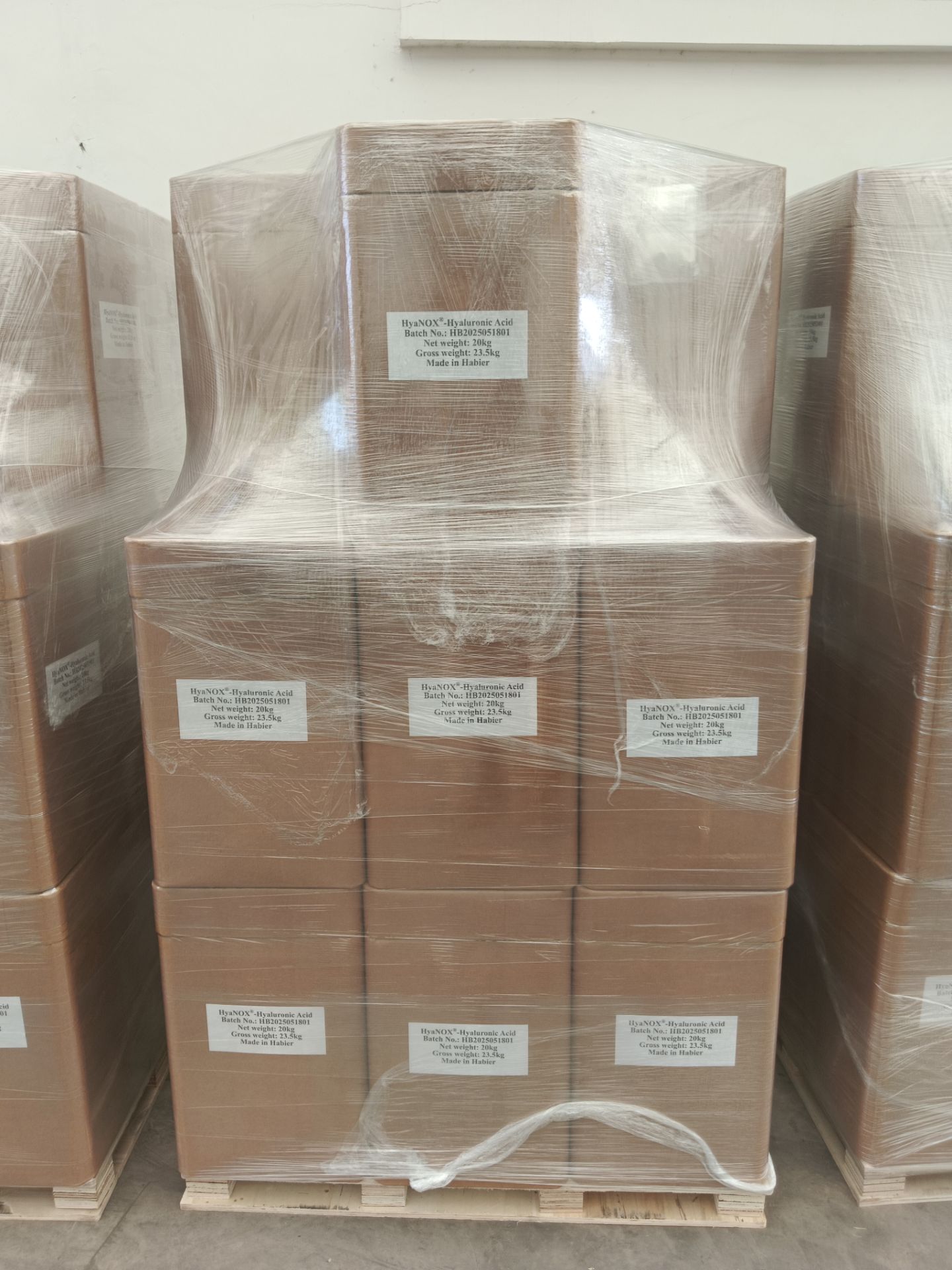
Export packaging for sodium hyaluronate raw material shipments. Image source: Shandong Habier Biopharma Co.,LTD.
Problem Definition: What a Customs Clearance Hurdle Actually Is
A customs clearance hurdle is a missing, inconsistent, or late document that stops the broker from filing a complete entry. For sodium hyaluronate, the product can be fully compliant and still sit at the port because the file does not prove what the shipment is, where it came from, how it was treated, or who is authorized to import it.
Four document gaps account for most of the friction in raw material shipments:
- Origin and treatment proof: the material is animal-derived, but the official veterinary heat treatment certificate is absent, incomplete, or not tied to the batch.
- Import authorization: the USDA import permit is missing, expired, or does not match the consignee or shipment.
- Grade identity: the invoice, packing list, label, and COA describe different grades or molecular weight ranges.
- Batch traceability: the COA batch number cannot be linked to the packaging, pallet, or production record.
Avian-origin sodium hyaluronate adds the first layer because the origin story must be documented before the commercial story matters. In the 4,733 kg case, the reverse happened: the veterinary heat treatment certificate, the APHIS-standard confirmation, and the USDA permit were complete before departure, so clearance became a document review rather than an exception process.
Industry Background: Why Sodium Hyaluronate Needs a File, Not Just a COA
Industrial hyaluronic acid is produced either by extraction from animal tissues or by large-scale bacterial fermentation with genetically modified strains. A 2016 peer-reviewed review describes these two industrial routes. The production route matters at the border because animal-derived material and fermentation-derived material carry different documentation profiles.
For a US importer, the grade also changes the file. Food grade sodium hyaluronate is used in oral health care supplements. Cosmetic grade sodium hyaluronate is used in emulsions, serums, and other skincare formats. Pharma grade and high molecular weight grades serve applications where the molecular weight range is part of the specification. Low molecular weight and hydrolyzed forms serve formulators who need a shorter chain length.
Habier's published grade ranges are specific: food grade at 0.8–1.5 million Da, cosmetic grade at 1.0–1.5 million Da, pharma grade at minimum 2.0 million Da, high molecular weight grade at minimum 2.0 million Da, and low molecular weight grade at maximum 0.1 million Da. These ranges matter in a clearance file because the COA, label, and commercial invoice must point to the same grade and the same specification.
The company operates a 50,000 m² facility with 123 employees, six engineers, and annual output of 600–700 MT. Its export ratio is 20%, with main markets in the EU, USA, and Korea. That export profile makes US documentation a routine operating requirement rather than an occasional project.

Extraction tank used in sodium hyaluronate production. Image source: Shandong Habier Biopharma Co.,LTD.
Detailed Solution: The Documentation Stack That Cleared the 4,733 kg Shipment
The solution is not a single certificate. It is a stack of documents that answer four border questions in order: what is the material, where did it come from, how was it treated, and who is authorized to import it. The 4,733 kg US shipment shows how the stack works in practice.
1. Origin and veterinary treatment file
The material was avian-origin hyaluronic acid raw material. It was accompanied by complete official veterinary heat treatment certification. That certificate is the first document a US importer should request because it connects the animal origin to an official treatment record. Without it, the rest of the file cannot answer the origin question.
For buyers, the practical check is not simply whether a certificate exists. The certificate must identify the material, the treatment, and the batch or shipment it covers. A certificate that cannot be linked to the 4,733 kg release is a document, not evidence.
2. US APHIS import-standard confirmation
The case record states that the material met US APHIS import standards. This is the second layer because it translates the origin and treatment file into the import-standard language that the US side expects to review. The confirmation should be in writing and should refer to the product and shipment, not to a generic product family.
This is also where grade identity becomes important. The APHIS-standard confirmation, the COA, and the commercial invoice should all describe product 5243 with the same grade and the same end use. A mismatch between cosmetic raw material and oral health care supplement raw material can turn a routine review into a query.
3. Valid USDA import permit
The shipment cleared smoothly with support from a valid USDA import permit. The permit is the authorization layer. It should be checked before booking, not after the container is on the water. The practical checks are the validity dates, the consignee details, and the consistency between the permit and the shipment documents.
In the 4,733 kg case, the permit was part of a pre-built file. That sequence matters. A permit obtained late can still be valid, but it creates a documentary gap that a broker may have to resolve under time pressure.
4. Batch quality file: COA and pre-shipment testing
The quality layer is the Certificate of Analysis. Habier's purchasing terms state that acceptance is based on a pre-shipment full test with a COA report, with support for third-party laboratory inspection and on-site factory inspection. The company also states 100% full inspection before delivery.
The COA should be treated as a traceability document, not only as a specification sheet. Its batch number must match the labels, the packing list, and the release record. When a US importer receives a COA that cannot be tied to the pallet, the clearance file is incomplete even if the test results are acceptable.
5. Traceability and packaging records
The case highlights stable batch quality and long-term repeat order cooperation. That outcome depends on traceability. Bulk carton pallet packaging, pallet-level labels, and a batch map allow the importer to connect the shipping unit to the production record.
A practical traceability file for a US shipment should show the batch number, the grade, the net weight, the packaging format, and the pallet or carton identity. For the 4,733 kg shipment, the commercial quantity and the batch records had to agree. That agreement is what makes repeat orders easier: the next shipment can follow the same document map.
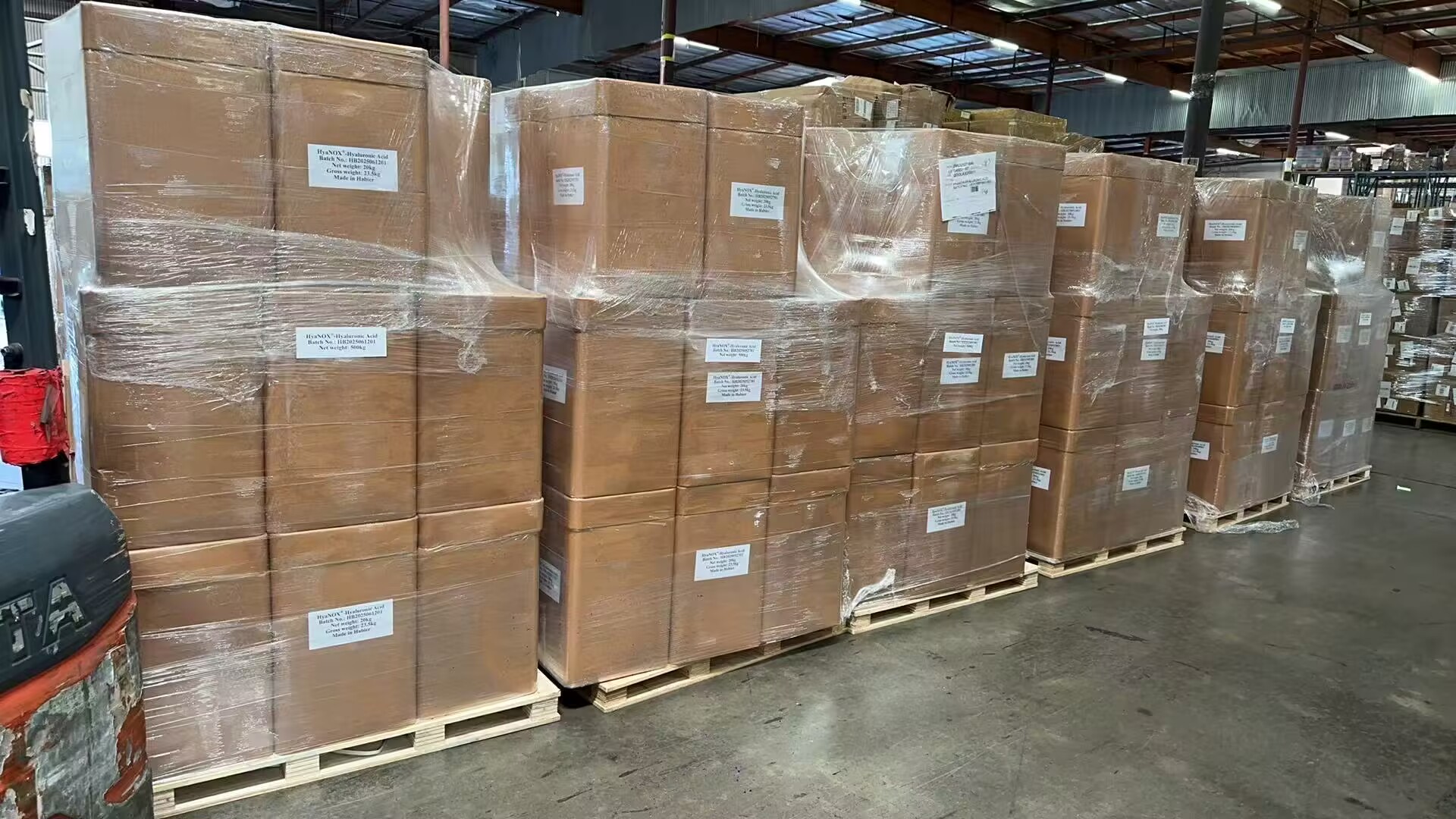
Bulk carton pallet packaging format used for raw material shipments. Image source: Shandong Habier Biopharma Co.,LTD.
6. Management system certificates as backup
The management system layer supports the file but does not replace the shipment-specific documents. Habier holds ISO 22000:2018 Food Safety Management System Certificate 104FSMS2400001, issued by SHANDONG SEATONE INTERNATIONAL CERTIFICATION CO.,LTD., with an expiry date of 2027-01-08. The scope covers sales of Sodium Hyaluronate (Hyaluronic Acid) and Chondroitin Sulfate and related food safety management activities.
The company also holds ISO 9001:2015 Quality Management System Certificate 1042Q00053R0S, issued by SHANDONG SEATONE INTERNATIONAL CERTIFICATION CO.,LTD, with an expiry date of 2027-01-08. The standard is GB/T 19001-2016 / ISO 9001:2015. These certificates help a buyer verify that the supplier operates a management system, but the customs file still depends on the veterinary certificate, the APHIS-standard confirmation, the USDA permit, the COA, and the batch records.
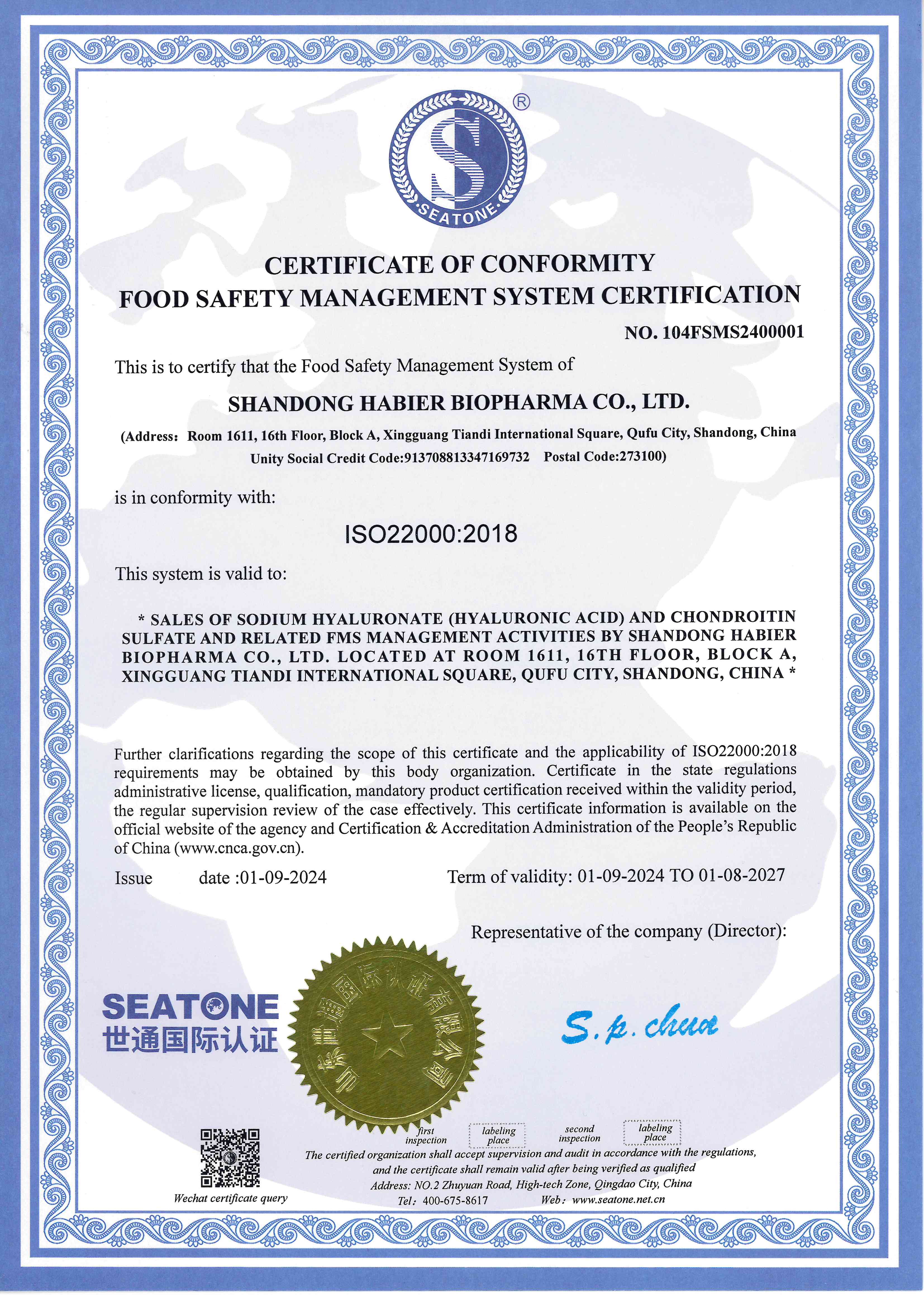
ISO 22000:2018 certificate 104FSMS2400001, valid to 2027-01-08. Image source: Shandong Habier Biopharma Co.,LTD.
Step-by-Step Breakdown: How to Build a US Clearance File Before Booking
The 4,733 kg case can be converted into a repeatable sequence. The sequence is written from the importer's side because the importer controls the permit and the broker instructions, while the supplier controls the origin, treatment, quality, and batch records.
- Fix the end use and grade first. Decide whether the material is for cosmetic raw material, oral health care supplement raw material, or another application. Then select the grade and molecular weight range. A food grade request at 0.8–1.5 million Da is a different document set from a pharma grade request at minimum 2.0 million Da.
- Confirm animal origin and certificate availability. Ask for the official veterinary heat treatment certificate before the quotation is finalized. The certificate must cover the material and the batch, not just the product category.
- Put the APHIS-standard confirmation in writing. The supplier should state that the material meets US APHIS import standards and identify the product and shipment. Keep this confirmation with the veterinary certificate.
- Validate the USDA import permit before booking. Check the permit validity, consignee, and shipment details. If the permit is not ready, the booking date should move, not the document review.
- Lock the specification and COA format. Agree on the grade, molecular weight range, packaging, and COA content. The COA should include the batch number and the test results that the importer will review at release.
- Run pre-shipment inspection and a document cross-check. Habier's terms include a pre-shipment full test with a COA report, third-party laboratory inspection, and on-site factory inspection. Use the inspection to compare the invoice, packing list, COA, labels, and pallet records before the shipment leaves.
- Align shipping terms and broker instructions. Delivery terms are FOB or CIF. Give the broker a single document index that lists the veterinary certificate, APHIS-standard confirmation, USDA permit, COA, invoice, packing list, and batch records.
- Close the loop with a repeat-order file. After clearance, keep the approved document set as the template for the next shipment. The case ended in long-term repeat order cooperation because the batch quality and the document map were stable.
Execution rule: do not treat the USDA permit as a substitute for the veterinary certificate, and do not treat the ISO certificates as a substitute for the shipment-specific file. Each document answers a different border question.
Use Cases: Where This Documentation Model Fits
US natural cosmetic and health supplement importer
This is the case scenario. The importer needed hyaluronic acid raw material for cosmetic raw material and oral health care supplement raw material applications. The 4,733 kg shipment combined avian-origin material, official veterinary heat treatment certification, US APHIS import-standard confirmation, and a valid USDA import permit. The result was smooth customs clearance, stable supply of high-purity hyaluronic acid raw material, and long-term repeat order cooperation.
Cosmetic formulator using cosmetic grade sodium hyaluronate
A cosmetic formulator typically works with cosmetic grade sodium hyaluronate at 1.0–1.5 million Da. The clearance file still needs the origin and treatment documents if the material is animal-derived, plus a COA that matches the grade and batch. The grade identity should be consistent across the label, invoice, and COA.
Oral supplement brand using food grade sodium hyaluronate
An oral health care supplement brand typically uses food grade sodium hyaluronate at 0.8–1.5 million Da. For this use, the end-use statement and the COA should match the food grade specification. The ISO 22000:2018 certificate supports the food safety management system, while the shipment-specific documents support the entry.
Pharma or high molecular weight buyer
A pharma grade buyer works with a minimum 2.0 million Da specification. A high molecular weight buyer uses the same minimum 2.0 million Da range. These grades require a precise COA and a clear link between the batch and the shipping unit. The veterinary and APHIS documents remain part of the file when the material is animal-derived.
Formulator using low molecular weight or hydrolyzed material
Low molecular weight sodium hyaluronate is specified at maximum 0.1 million Da. A formulator using low molecular weight or hydrolyzed material should confirm that the COA, label, and invoice all use the same grade name and molecular weight description. A grade mismatch is a documentation problem even when the material is correct.
OEM and ODM private label project
Habier provides OEM and ODM services with purity adjustment. The minimum order quantity is 1 kg, the typical lead time is 5–8 days, and monthly production capacity is 50–60 tons. For an OEM project, the clearance file should be built around the final grade and end use, not around a generic sodium hyaluronate description.
Comparison Table: Clearance Document Matrix From the 4,733 kg US Shipment
The table below maps each document to the border question it answers and to the evidence in the case. The final column is a buyer check, not a legal requirement.
| Document or record | What it establishes | Evidence in the 4,733 kg case | Buyer check before booking |
|---|---|---|---|
| Official veterinary heat treatment certificate | The avian-origin material has an official heat treatment record | Complete official veterinary heat treatment certification | Confirm the certificate covers the actual batch and material |
| US APHIS import-standard confirmation | The material meets US APHIS import standards | Met US APHIS import standards | Obtain written confirmation tied to product 5243 and the shipment |
| Valid USDA import permit | Import authorization is in place | Clearance supported by a valid USDA import permit | Check validity dates and consignee details |
| Certificate of Analysis | The batch meets the agreed specification | Pre-shipment full test with COA report | Match the COA batch number to labels and packing list |
| ISO 22000:2018 certificate | Food safety management system is certified | Certificate 104FSMS2400001, valid to 2027-01-08 | Verify the scope includes sodium hyaluronate |
| ISO 9001:2015 certificate | Quality management system is certified | Certificate 1042Q00053R0S, valid to 2027-01-08 | Verify current validity |
| Commercial invoice and packing list | Quantity, value, buyer, seller, and shipment identity | 4,733 kg shipment to a US importer | Cross-check weight, grade, batch, and consignee |
| Batch and packaging traceability records | The product can be traced from production to pallet | Stable batch quality and long-term repeat orders | Ask for pallet-level labels and a batch map |
FAQ
What documents support US customs clearance for avian-origin sodium hyaluronate?
The 4,733 kg US shipment cleared with three case-specific documents on the critical path: complete official veterinary heat treatment certification for the avian-origin material, confirmation that the material met US APHIS import standards, and a valid USDA import permit. The supplier also provided a pre-shipment full test with a COA report, and holds ISO 22000:2018 certificate 104FSMS2400001 and ISO 9001:2015 certificate 1042Q00053R0S, both valid to 2027-01-08.
Can one supplier cover cosmetic and oral supplement grades?
Yes. Product 5243 covers food grade, cosmetic grade, pharma grade, high molecular weight grade, and low molecular weight grade. The published molecular weight ranges are 0.8–1.5 million Da for food grade, 1.0–1.5 million Da for cosmetic grade, minimum 2.0 million Da for pharma grade, minimum 2.0 million Da for high molecular weight grade, and maximum 0.1 million Da for low molecular weight grade. The same manufacturer offers OEM and ODM services with purity adjustment.
What are the minimum order quantity, delivery terms, and payment terms?
The minimum order quantity is 1 kg. Delivery terms are FOB or CIF. Acceptance is based on a pre-shipment full test with a COA report; third-party laboratory inspection and on-site factory inspection are supported. Payment terms can be negotiated separately for large long-term clients, while the main mode is high advance payment.
Can I request a sample before placing an order?
Free sample supply is available, with after-sales quality tracking. A sample request should state the target grade, end use, and estimated volume so the sample matches the production batch. Contact Jake Chen at jake@habier.com or +86-186-0537-0487, or download the brochure at https://cdn.socialarks.com/sbsp/24956/common/2026/0617/%E6%B5%B7%E8%B4%9D%E5%B0%94%E5%AE%A3%E4%BC%A0%E5%86%8C.pdf.
What is the typical lead time and monthly production capacity?
Typical production lead time is 5–8 days, with monthly production capacity of 50–60 tons. The company operates a 50,000 m² facility with 123 employees, six engineers, and annual output of 600–700 MT. For a US shipment, confirm the USDA import permit and the veterinary certificate before booking. To discuss a quotation, contact Jake Chen at jake@habier.com or +86-186-0537-0487.
Conclusion: Clearance Is a Pre-Shipment Discipline
The 4,733 kg US shipment is a practical example of how sodium hyaluronate clearance works when the file is built in the right order. The avian-origin material had complete official veterinary heat treatment certification, met US APHIS import standards, and was supported by a valid USDA import permit. The quality file, batch traceability, and management system certificates supported the release. The result was smooth customs clearance, stable batch quality, and long-term repeat order cooperation.
For importers, the lesson is to treat clearance as a pre-shipment discipline. Confirm the grade and end use, obtain the veterinary certificate, put the APHIS-standard confirmation in writing, validate the USDA permit, match the COA to the batch, and cross-check every document before booking. That sequence reduces the chance that a compliant material becomes a delayed shipment.
Next Step
If you are evaluating a US-bound sodium hyaluronate project, request a sample or a quotation with the target grade, end use, and estimated volume. Shandong Habier Biopharma Co.,LTD can support the document package with the veterinary certificate, APHIS-standard confirmation, COA, ISO 22000:2018 certificate 104FSMS2400001, and ISO 9001:2015 certificate 1042Q00053R0S.
Visit www.habier.com or download the product brochure.
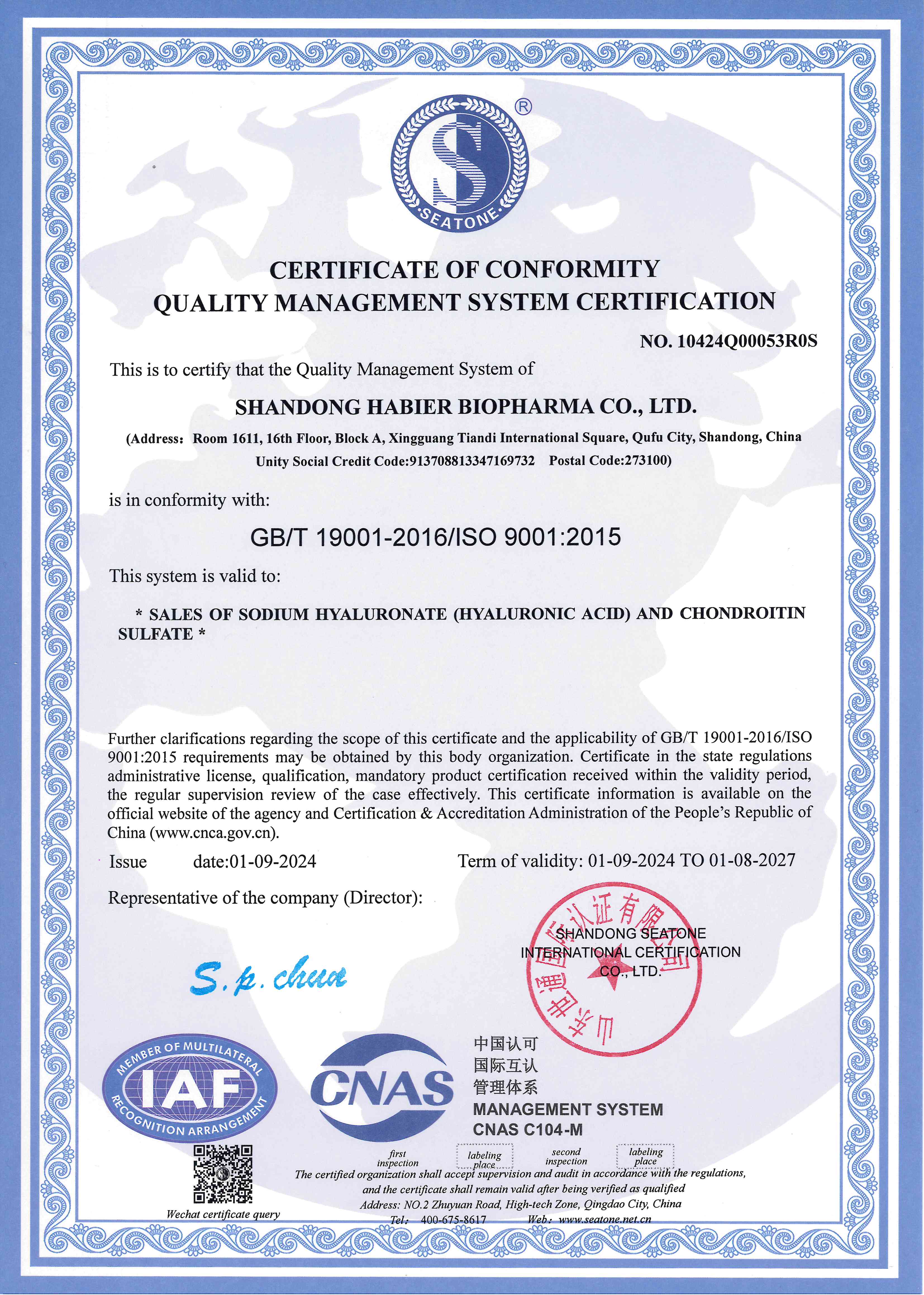
ISO 9001:2015 certificate 1042Q00053R0S, valid to 2027-01-08. Image source: Shandong Habier Biopharma Co.,LTD.
Contact: Jake Chen
Email: jake@habier.com
Tel: +86-186-0537-0487
Address: 16F Building A Xingguangtiandi International Square, Qufu City, Shandong, China 273100
This article describes a documented shipment and general documentation practice. Importers should verify current US import requirements with their customs broker and the relevant US authority before shipment.
Have Questions or Need More Details?
Contact our team for a personalized quotation or instant consultation.
Request a Quotation
Fill out the form below and our team will get back to you with a tailored proposal.
WhatsApp Direct Chat
Prefer to chat in real-time? Message us on WhatsApp for instant assistance & quick answers.
- Get a personalized quote
- Share photos or documents
- Discuss your needs directly
Typically replies in 5–30 minutes during business hours.