
Sodium Hyaluronate Import Compliance: ISO, Kosher, Halal, Ecocert & US APHIS Guide
Sodium Hyaluronate Import Compliance: ISO, Kosher, Halal, Ecocert & US APHIS Guide
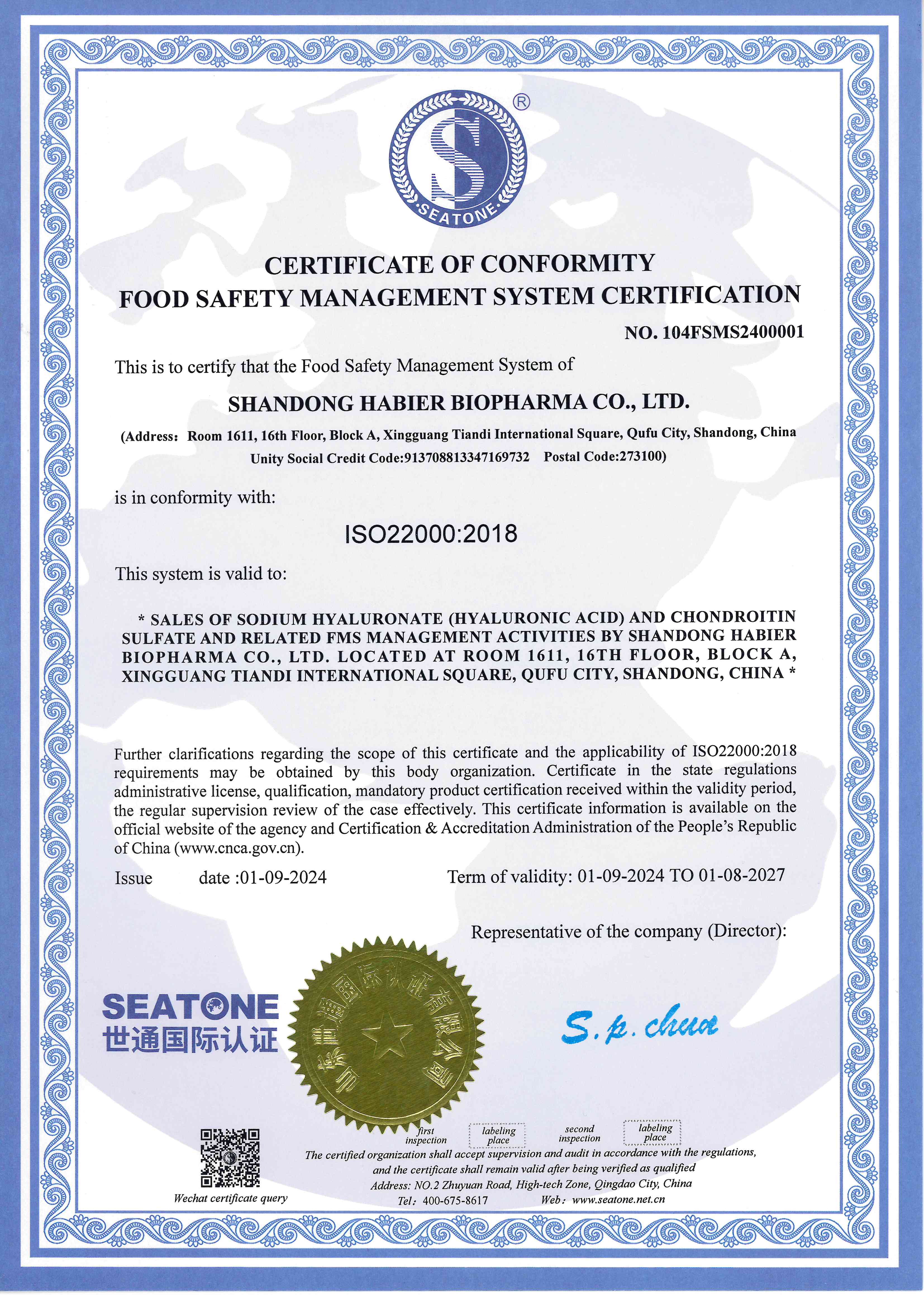
ISO 22000:2018 certificate 104FSMS2400001, issued for the sales of sodium hyaluronate (hyaluronic acid) and chondroitin sulfate and related food safety management activities.
Sodium hyaluronate import compliance is decided on paper before it is decided at the port. A shipment of hyaluronic acid sodium salt can meet every physical specification and still be held if the certificate numbers, the declared sales scope, the origin statement, or the batch-level records do not match what the importer filed.
For US buyers — cosmetic formulators, supplement brands and importers of natural personal care ingredients — the compliance file for this material normally has five layers: ISO management system certificates, Kosher and Halal attestations, organic certification where an organic claim is used, batch testing and full-inspection records, and, when the raw material is animal-derived, official veterinary heat treatment certification for US APHIS purposes.
This guide explains how those layers are documented for Sodium Hyaluronate (product code 5243) supplied by Shandong Habier Biopharma Co., Ltd., a manufacturer and supplier of sodium hyaluronate (hyaluronic acid) and chondroitin sulfate based in Qufu City, Shandong Province, China. The company runs a 50,000 m² facility with 123 employees and an annual output of 600–700 MT, holds a qualification system that includes dual ISO certification, HACCP, Kosher and Halal, and supplies a product certified as organic COSMOS and to ISO 16128. Its export mix covers the EU, USA and Korea, with exports accounting for 20% of output.
Problem Definition: Where Sodium Hyaluronate Imports Actually Stall
Most customs delays on sodium hyaluronate shipments are not caused by the ingredient itself. They are caused by a mismatch between what the supplier's certificate says and what the buyer declared.
Six recurring compliance gaps
- A certificate scope that does not name the product or the activity. A quality certificate can be entirely valid and still be written around a different product line or a different business activity than the one being imported. The scope wording is what customs and internal QA read first.
- A validity window that does not cover the shipment date. Management system certificates run on fixed terms. A document that was current when the purchase order was signed may expire before the container lands.
- Missing animal-origin documentation. Where the material is derived from animal tissue, US clearance follows a separate track from ingredient safety alone, and the veterinary certification must be complete and officially issued.
- Verbally confirmed Kosher or Halal status with no certificate copy. Religious-compliance claims need supporting documentation in the file, not a line in a quotation.
- An organic claim without a recognised standard behind it. Cosmetic and personal-care customers increasingly require the organic claim to be tied to a defined certification scheme rather than a marketing description.
- No batch-level evidence for the delivered lots. Full-item inspection only creates value if the records for the specific batch can be produced on request.
Each of these gaps is preventable at the sourcing stage. The sections below show what the documentation actually looks like for one verified sodium hyaluronate supply line, and how a buyer can check it step by step.
Industry Background: Why Documentation Now Carries Commercial Weight
Industrial hyaluronic acid is produced through two established routes: extraction from animal tissues, or large-scale bacterial fermentation using genetically modified strains. Both routes remain commercially active, and the route a supplier uses determines which import documents apply. For US-bound material, animal-derived inputs trigger veterinary and APHIS documentation that fermentation-derived material does not require — a distinction that should be established before a purchase order, not after a container is booked.
The commercial stakes behind that paperwork are considerable. The global hyaluronic acid market reached USD 11.64 billion in 2025 according to Fortune Business Insights, and pharmaceutical-grade hyaluronic acid accounted for 69.3% of product segment share in 2026 in the same source. Grade mix therefore drives both price and documentation expectations: pharmaceutical grades carry the strictest evidence requirements, while food and cosmetic grades carry their own food-safety, religious-certification and organic obligations.
The practical consequence is that supplier evaluation has shifted from a single quality question to a documentation question. A supplier that can produce the certificate, the scope statement, the batch record and the origin certification quickly shortens customs clearance. A supplier that cannot creates demurrage, re-testing and re-labelling costs that rarely appear in the quoted price per kilogram.
The Compliance Stack Behind Sodium Hyaluronate Product 5243
Sodium hyaluronate supplied as product 5243 is documented through a layered set of certificates and records covering quality management, food safety, religious compliance, organic cosmetic claims, batch inspection and animal-origin import requirements.
The two certificate numbers a US buyer should verify first:
- ISO 9001:2015 (GB/T 19001-2016 / ISO 9001:2015) — certificate 1042Q00053R0S, issued by SHANDONG SEATONE INTERNATIONAL CERTIFICATION CO.,LTD, issued 1 September 2024, valid to 8 January 2027, applicable to the global market.
- ISO 22000:2018 — certificate 104FSMS2400001, issued by SHANDONG SEATONE INTERNATIONAL CERTIFICATION CO.,LTD, issued 1 September 2024, valid to 8 January 2027, applicable to the global market.
ISO 9001:2015 — Quality Management Coverage
The ISO 9001 certificate held for Sodium Hyaluronate (product 5243) carries certificate number 1042Q00053R0S and is issued against GB/T 19001-2016 / ISO 9001:2015 by SHANDONG SEATONE INTERNATIONAL CERTIFICATION CO.,LTD. Its declared scope is recorded as ALL, the issue date is 1 September 2024, and it remains valid until 8 January 2027.
Two details in that record matter more than the certificate's existence. The first is timing: the validity window runs to 8 January 2027, so an importer taking delivery in the current period is working with a certificate that has not expired. The second is the certificate's stated market: it applies to the global market, which means it is not restricted to a domestic sales territory and can be presented for an export shipment without a scope challenge.
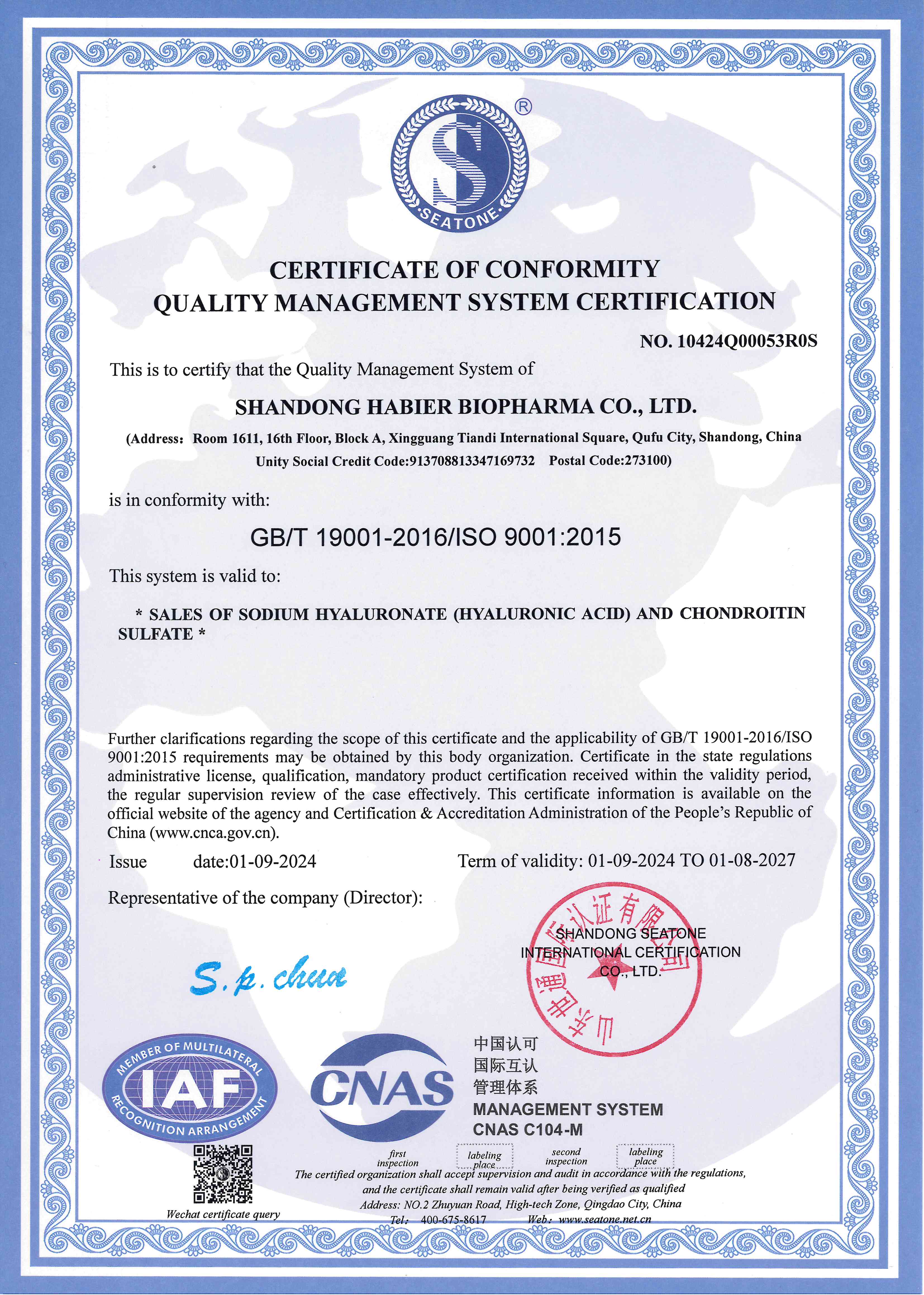
ISO 9001:2015 (GB/T 19001-2016 / ISO 9001:2015) certificate 1042Q00053R0S, issued by SHANDONG SEATONE INTERNATIONAL CERTIFICATION CO.,LTD.
ISO 22000:2018 — Food Safety Management for Food and Supplement Buyers
The food safety certificate for the same product is numbered 104FSMS2400001 and is issued to ISO 22000:2018, again by SHANDONG SEATONE INTERNATIONAL CERTIFICATION CO.,LTD, with the same issue date of 1 September 2024 and the same expiry date of 8 January 2027.
Its scope reads: sales of Sodium Hyaluronate (Hyaluronic Acid) and Chondroitin Sulfate and related food safety management activities. That wording is worth reading closely during supplier qualification, because the certificate is written around the sales activity for sodium hyaluronate and chondroitin sulfate specifically, rather than around a generic site description. Importers declaring the material as a food or supplement ingredient should confirm that the scope language covers the activity being certified, and that it matches the product named on the commercial invoice and the customs declaration.
Kosher, Halal and HACCP
Religious-compliance documentation is a separate track from ISO certification, and it is frequently the point where a supplement or functional food project stalls. The company's qualification system includes dual ISO certification, HACCP, Kosher and Halal.
For a US importer, the operational advice is straightforward: request the Kosher and Halal documentation as attachments during sampling, not after the production slot is booked. A supplier that can place those documents in the file at quotation stage is signalling that the certificate is maintained and retrievable, which is what a certification reviewer will eventually ask for.
COSMOS Organic Certification and ISO 16128 for Cosmetic Claims
Cosmetic buyers face a claim-verification problem as much as an import problem. An organic or naturally derived claim on a finished serum, emulsion or mask has to be traceable to the ingredient supplied. For this product, the certification position is that the product is certified as both organic COSMOS and ISO 16128.
For a formulator, that means the raw material record can be carried into a cosmetic formulation file without creating a documentation gap between the supplier's claim and the brand's own on-pack statement. This is the practical reason COSMOS and ISO 16128 documentation is now requested alongside the specification sheet rather than months later during a claim audit.
Batch Testing, Full Inspection and Traceability Records
Certificates describe a system. Batch records describe an actual delivery. The quality control protocol for this supply line specifies 100% full inspection before delivery, which means the material is not released against statistical sampling alone.
For an importer, the corresponding action is to request the inspection documentation for the batch that will be shipped, and to keep it with the certificate copies and the transport documents. Where a buyer needs traceability from incoming raw material through to a finished lot, the starting point is the batch-linked inspection record, not the management system certificate.
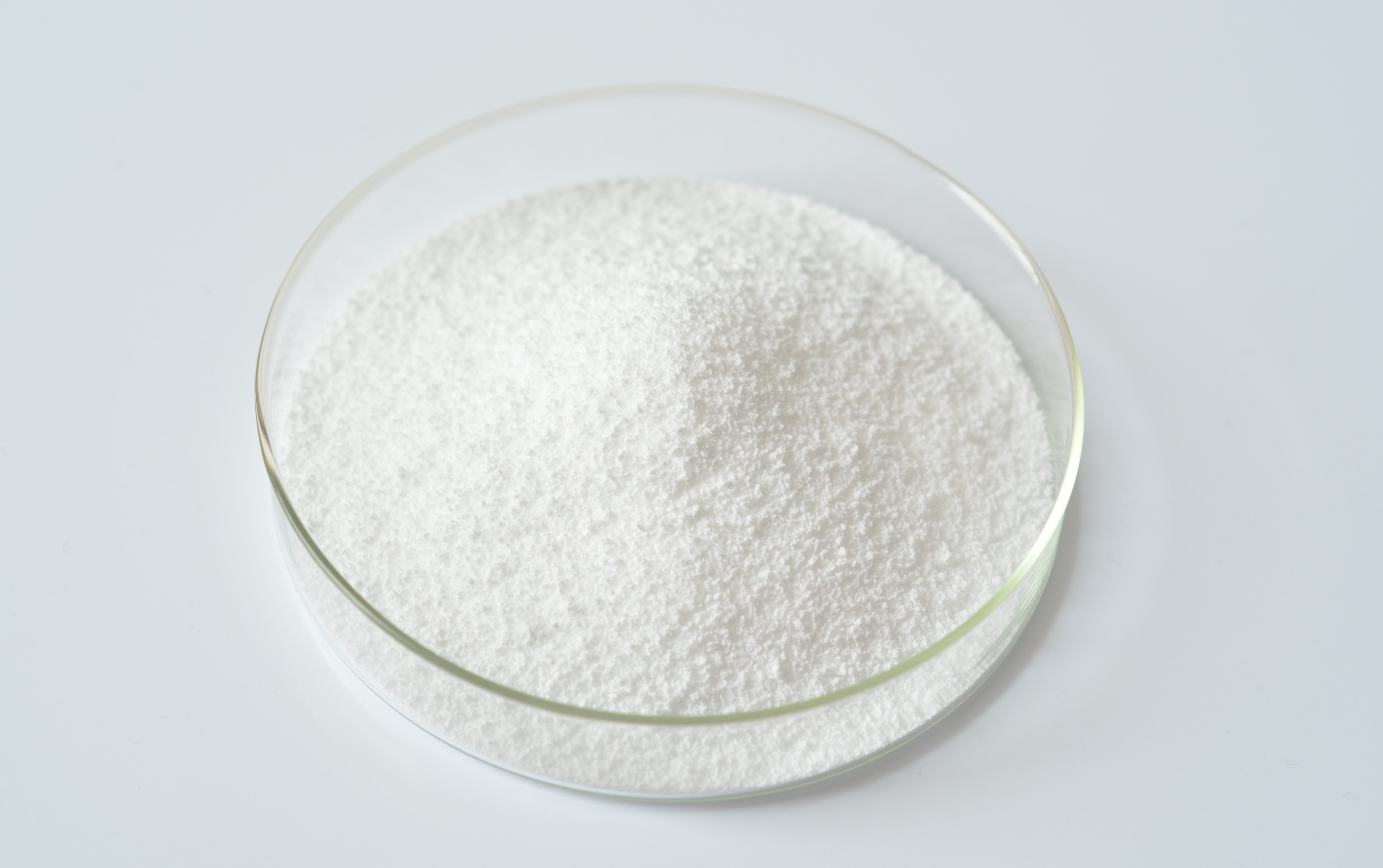
Batch-level testing supports the 100% full inspection protocol applied before delivery.
Management system certificates are also not permanent documents. Both ISO certificates show a defined validity window from 1 September 2024 to 8 January 2027, and certificates of this type are normally maintained through periodic third-party surveillance and recertification audits by the issuing body. That is why experienced buyers re-check certificate validity and scope at each annual contract renewal instead of relying on a file collected years earlier.
US APHIS: Veterinary Heat Treatment Certification for Animal-Origin Material
When sodium hyaluronate originates from animal tissue rather than fermentation, US import clearance adds a veterinary layer. The documented supply record for a US-bound shipment describes avian-origin raw material covered by complete official veterinary heat treatment certification, meeting US APHIS import standards and clearing customs with a valid USDA import permit.
The buyer-side lesson is that this documentation is prepared before shipment, not resolved at the border. An importer bringing animal-derived hyaluronic acid into the United States should confirm three things with the supplier at the order confirmation stage: that the material's origin is stated clearly, that the official veterinary heat treatment certification is complete for the specific lot, and that the import permit is valid for the shipment date. Where a project can use fermentation-derived material instead, the documentation track is different, and that choice should be made deliberately during grade selection rather than by default.
Step-by-Step: A Seven-Step Import Verification Workflow
The following sequence converts the documentation described above into a checking routine that a procurement or regulatory affairs team can run before each order.
- Fix the grade and molecular weight first. Food grade, cosmetic grade, pharma grade and the high, regular, low, super low, ultra low and hydrolyzed variants carry different documentation expectations. The declared grade on the invoice must match the specification actually shipped.
- Verify the ISO certificate numbers against the supplier's copies. For this supply line, ISO 9001:2015 is 1042Q00053R0S and ISO 22000:2018 is 104FSMS2400001, both issued by SHANDONG SEATONE INTERNATIONAL CERTIFICATION CO.,LTD.
- Check the validity window against the shipment date. Both certificates run from 1 September 2024 to 8 January 2027 and apply to the global market.
- Read the ISO 22000 scope wording. Confirm that the scope covers the sales of sodium hyaluronate (hyaluronic acid) and chondroitin sulfate and related food safety management activities, and that it aligns with the activity being imported.
- Collect the Kosher, Halal and HACCP documents as attachments. These sit within the company's qualification system and should be filed together with the ISO certificates.
- Establish the origin track and the US veterinary requirement. For avian-origin raw material, confirm complete official veterinary heat treatment certification meeting US APHIS import standards, plus a valid USDA import permit before the shipment departs.
- Close the loop on batch evidence and traceability. Request the inspection record for the shipped batch, confirm that 100% full inspection before delivery applies, and archive the batch record with the certificates and transport documents.
Use Cases: How the Documentation Plays Out in Practice
Use case 1 — A US natural cosmetic and health supplement importer
The clearest illustration of the full documentation stack is a documented shipment of 4,733 kg of sodium hyaluronate to a US importer of natural cosmetics and health supplements. The material served two purposes at the customer's site: cosmetic raw material and oral health care supplement raw material, and the relationship continued into long-term stable use.
The recorded result was a stable supply of hyaluronic acid raw material for the customer's laboratory, cosmetic and oral care mass production requirements, with smooth customs clearance supported by a valid USDA import permit. The shipment highlight is the compliance detail: avian-origin raw material carrying complete official veterinary heat treatment certification, meeting US APHIS import standards, with stable batch quality supporting repeat orders.
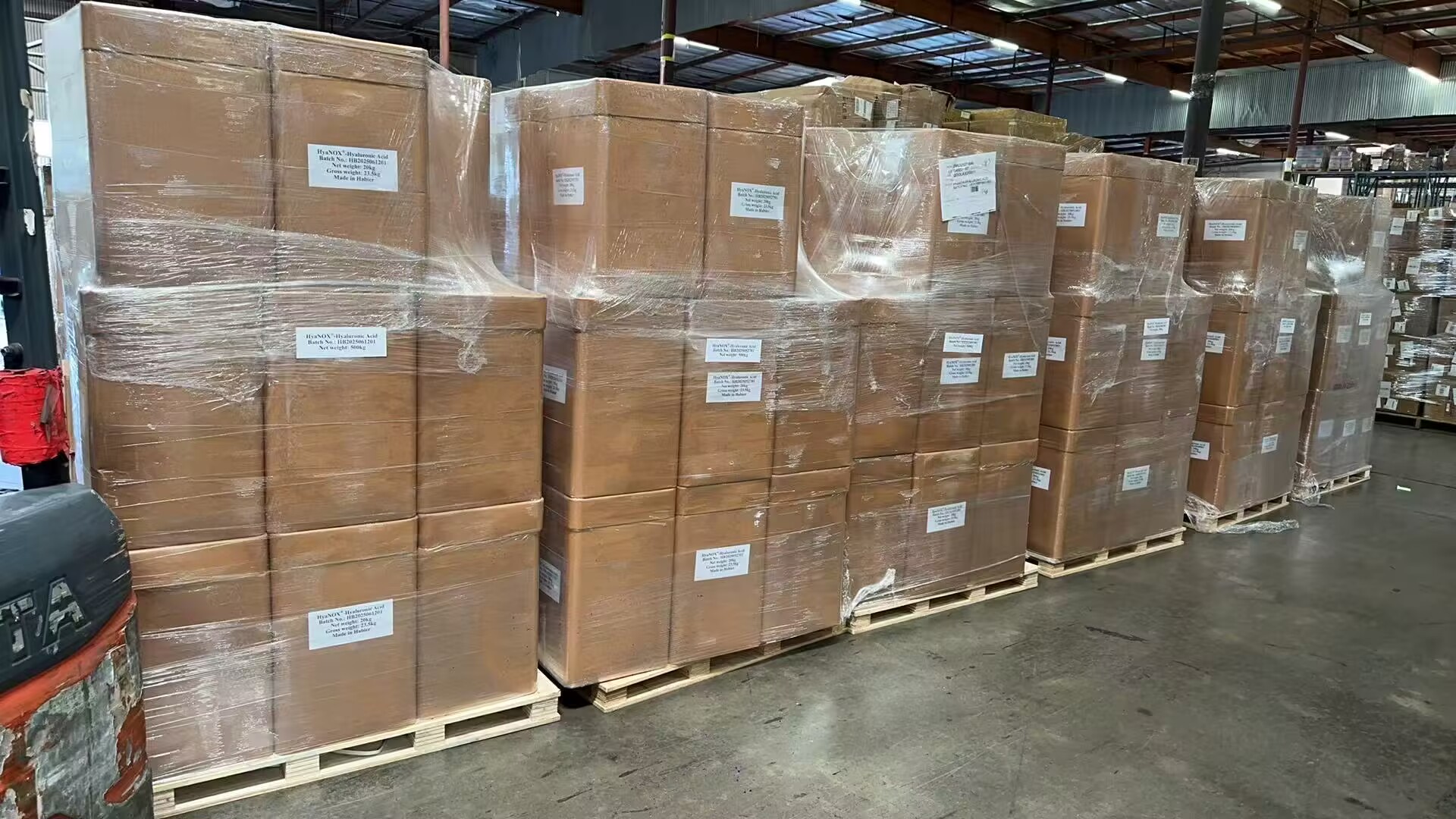
Bulk packaging formats used for exported sodium hyaluronate, including the documented 4,733 kg US shipment.
Use case 2 — A US cosmetic skincare raw material blending project
Cosmetic blending projects in the United States typically operate around continuous production, with low-temperature fermentation synthesis upstream and matched downstream equipment such as ultrafiltration purification units, sterile mixing tanks, vacuum emulsifiers, cleanroom filling machines, low-temperature drying ovens and microbial and heavy metal testing instruments.
In this setting, sodium hyaluronate commonly functions as a humectant, viscosity modifier, filler or viscoelastic material depending on the formulation. Where a project moves toward medical or injectable grade, the requirements change: aseptic cleanroom production, sterility considerations and low microbial limits enter the specification, and the documentation file needs to reflect that stricter positioning.
Use case 3 — Food and supplement grade sourcing
Food and supplement buyers work mainly against the food safety track. The relevant documents are the ISO 22000:2018 certificate, the HACCP, Kosher and Halal material held in the qualification system, and the batch inspection record for the shipped lot. Molecular weight selection is also constrained here: food grade sodium hyaluronate sits in the 0.8–1.5 million Da range, which is a different specification baseline from pharma grade.
Use case 4 — Pharmaceutical grade projects
Pharma grade sodium hyaluronate is specified at a minimum of 2.0 million Da, the same lower bound as the high molecular weight grade. Pharmaceutical-grade material carries the strictest expectations on testing, documentation and origin, and the automotive remark is that the certificate file must be complete before a production slot is reserved, not after.
Certification and Grade Comparison
The two tables below summarise the documented certification position for Sodium Hyaluronate (product 5243) and the molecular weight ranges that correspond to each grade.
Table 1 — Certification matrix for Sodium Hyaluronate (product 5243)
| Certification / standard | Certificate or reference | Issuing body | Scope | Validity / market |
|---|---|---|---|---|
| ISO 9001:2015 (GB/T 19001-2016 / ISO 9001:2015) | 1042Q00053R0S | SHANDONG SEATONE INTERNATIONAL CERTIFICATION CO.,LTD | Quality management; scope recorded as ALL | Issued 1 Sep 2024, valid to 8 Jan 2027; global market |
| ISO 22000:2018 | 104FSMS2400001 | SHANDONG SEATONE INTERNATIONAL CERTIFICATION CO.,LTD | Sales of Sodium Hyaluronate (Hyaluronic Acid) and Chondroitin Sulfate and related food safety management activities | Issued 1 Sep 2024, valid to 8 Jan 2027; global market |
| HACCP | Part of the company qualification system | Not specified in this document set | Food safety risk control | Company qualification system |
| Kosher | Part of the company qualification system | Not specified in this document set | Religious dietary compliance | Company qualification system |
| Halal | Part of the company qualification system | Not specified in this document set | Religious dietary compliance | Company qualification system |
| Organic COSMOS and ISO 16128 | Product-level certification | Not specified in this document set | Support for organic and naturally derived cosmetic claims | Product certification |
| Official veterinary heat treatment certification (US APHIS) | Accompanies avian-origin raw material; USDA import permit for the shipment | Not specified in this document set | Import of animal-origin material into the United States | Documented on the 4,733 kg US shipment |
Table 2 — Grade and molecular weight reference
| Grade / type | Molecular weight range | Typical documentation focus |
|---|---|---|
| Food grade | 0.8–1.5 million Da | ISO 22000:2018, HACCP, Kosher, Halal, batch inspection record |
| Cosmetic grade | 1.0–1.5 million Da | Organic COSMOS, ISO 16128, specification sheet |
| Pharma grade | Min. 2.0 million Da | Strictest testing, origin and documentation expectations |
| High molecular weight grade | Min. 2.0 million Da | Specification consistency across batches |
| Low molecular weight grade | Max. 0.1 million Da | Grade declaration accuracy on invoice and customs file |
| Super low / ultra low molecular weight; hydrolyzed hyaluronic acid | Defined per product type | Product-type identification in the technical file |
FAQ: Sodium Hyaluronate Import Compliance
1. Which certifications should a US importer verify on a sodium hyaluronate supplier?
For product 5243, the two verifiable management system certificates are ISO 9001:2015 (GB/T 19001-2016 / ISO 9001:2015), certificate number 1042Q00053R0S, and ISO 22000:2018, certificate number 104FSMS2400001. Both are issued by SHANDONG SEATONE INTERNATIONAL CERTIFICATION CO.,LTD, both were issued on 1 September 2024, both remain valid until 8 January 2027, and both apply to the global market. Food and supplement buyers should additionally request the HACCP, Kosher and Halal documentation held within the company's qualification system, while cosmetic buyers should request the certification confirming the product is certified as organic COSMOS and to ISO 16128.
2. What documentation does avian-origin sodium hyaluronate need to meet US APHIS import standards?
Animal-origin material needs more than an ingredient specification. In the documented 4,733 kg shipment to a US natural cosmetic and health supplement importer, the avian-origin raw material was covered by complete official veterinary heat treatment certification, met US APHIS import standards, and cleared customs smoothly with a valid USDA import permit. Buyers importing animal-derived sodium hyaluronate should confirm before departure that the veterinary heat treatment certification is complete for the lot and that the import permit is valid for the shipment date.
3. Can grade, molecular weight and purity be adjusted for a specific project?
Yes. The product range covers food grade, cosmetic grade and pharma grade, plus high molecular weight, regular grade, low molecular weight, super low molecular weight, ultra low molecular weight and hydrolyzed hyaluronic acid variants. Documented molecular weight ranges are 0.8–1.5 million Da for food grade, 1.0–1.5 million Da for cosmetic grade, a minimum of 2.0 million Da for pharma grade and high molecular weight grade, and a maximum of 0.1 million Da for low molecular weight grade. Purity adjustment is offered within an OEM/ODM production model, with monthly capacity of 50–60 tons.
4. How does sampling work before a bulk order?
Free sample supply forms part of the service package, together with after-sales quality tracking on delivered material. Because the minimum order quantity is 1 kg, a first order at that level works as a practical step between a free sample and a full production contract — it lets a buyer test handling, dissolution behaviour and documentation flow on a real commercial shipment before committing to bulk volume.
5. What is the lead time, and what accompanies the delivery?
The standard production lead time is 5–8 days, with 100% full inspection carried out before delivery, so the batch inspection record is available with the shipment rather than after it. For US-bound animal-origin material, the veterinary heat treatment certification and the USDA import permit travel with the same file. To request a sample, a quotation or the specification sheet for a specific grade, contact Jake Chen at jake@habier.com.
Conclusion: Compliance as a Purchasing Criterion
Sodium hyaluronate import compliance is not a single document but a chain: a quality management certificate with a checkable number, a food safety certificate whose scope names the product and the activity, Kosher and Halal attestations held inside the qualification system, organic COSMOS and ISO 16128 certification for cosmetic claims, batch inspection records produced before delivery, and — for animal-origin material entering the United States — complete official veterinary heat treatment certification meeting US APHIS import standards alongside a valid USDA import permit.
The documented 4,733 kg shipment to a US natural cosmetic and health supplement importer shows the chain working end to end: avian-origin raw material, complete veterinary certification, smooth customs clearance, and a supply relationship that continued on repeat orders. For a buyer, the transferable lesson is to check the certificate numbers, read the scope wording, confirm the validity window, and secure the batch record — before the purchase order, not after the container is on the water.
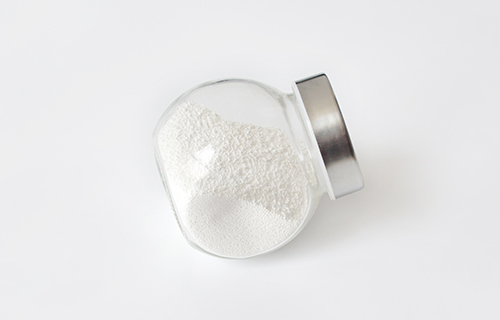
Samples are supplied free of charge so buyers can verify specification and documentation before a bulk order.
Next step: sample, specification sheet or quotation
Shandong Habier Biopharma Co., Ltd. supplies food grade, cosmetic grade and pharma grade sodium hyaluronate with ISO 9001:2015 (1042Q00053R0S) and ISO 22000:2018 (104FSMS2400001) certification, Kosher, Halal and HACCP documentation, organic COSMOS and ISO 16128 product certification, MOQ from 1 kg and a 5–8 day production lead time.
Download the company brochure for the full product and certification overview: Habier Biopharma brochure (PDF)
Contact: Jake Chen — jake@habier.com — Tel: +86-186-0537-0487 — www.habier.com
Have Questions or Need More Details?
Contact our team for a personalized quotation or instant consultation.
Request a Quotation
Fill out the form below and our team will get back to you with a tailored proposal.
WhatsApp Direct Chat
Prefer to chat in real-time? Message us on WhatsApp for instant assistance & quick answers.
- Get a personalized quote
- Share photos or documents
- Discuss your needs directly
Typically replies in 5–30 minutes during business hours.