
Mastering Molecular Weight: The Technical Guide to Sodium Hyaluronate Grades
Mastering Molecular Weight: The Technical Guide to Sodium Hyaluronate Grades
Sodium hyaluronate is the sodium salt of hyaluronic acid, and it is bought and specified by grade — food grade, cosmetic grade, pharma grade — but it is selected by molecular weight. The grade label tells a formulator or a procurement team which regulatory and application pathway a material is intended for. The molecular weight (MW) band tells them how that material will actually behave: how it dissolves, how much viscosity it builds, how it films on skin, how it survives heat and shear during processing, and how it reads in a finished-product claim.
This technical guide is written for two readers who usually meet over the same specification sheet: the formulator who has to make the material work, and the procurement specialist who has to make it repeatable, compliant and commercially sane. It maps the MW bands that Shandong Habier Biopharma Co., Ltd supplies, explains what each band is for, and sets out a step-by-step procedure for locking a molecular weight specification before an order is placed.
Molecular weight ranges in the Habier sodium hyaluronate range: Low MW grade — Max. 0.1 Million Da (including Hydrolyzed, Ultra Low and Super Low molecular weight sodium hyaluronate and hyaluronic acid); Food grade — 0.8–1.5 Million Da; Cosmetic grade — 1.0–1.5 Million Da; Pharma grade — Min. 2.0 Million Da; High MW grade — Min. 2.0 Million Da. The product is supplied as Sodium Hyaluronate / Hyaluronic Acid sodium salt for food, cosmetic and pharmaceutical applications.
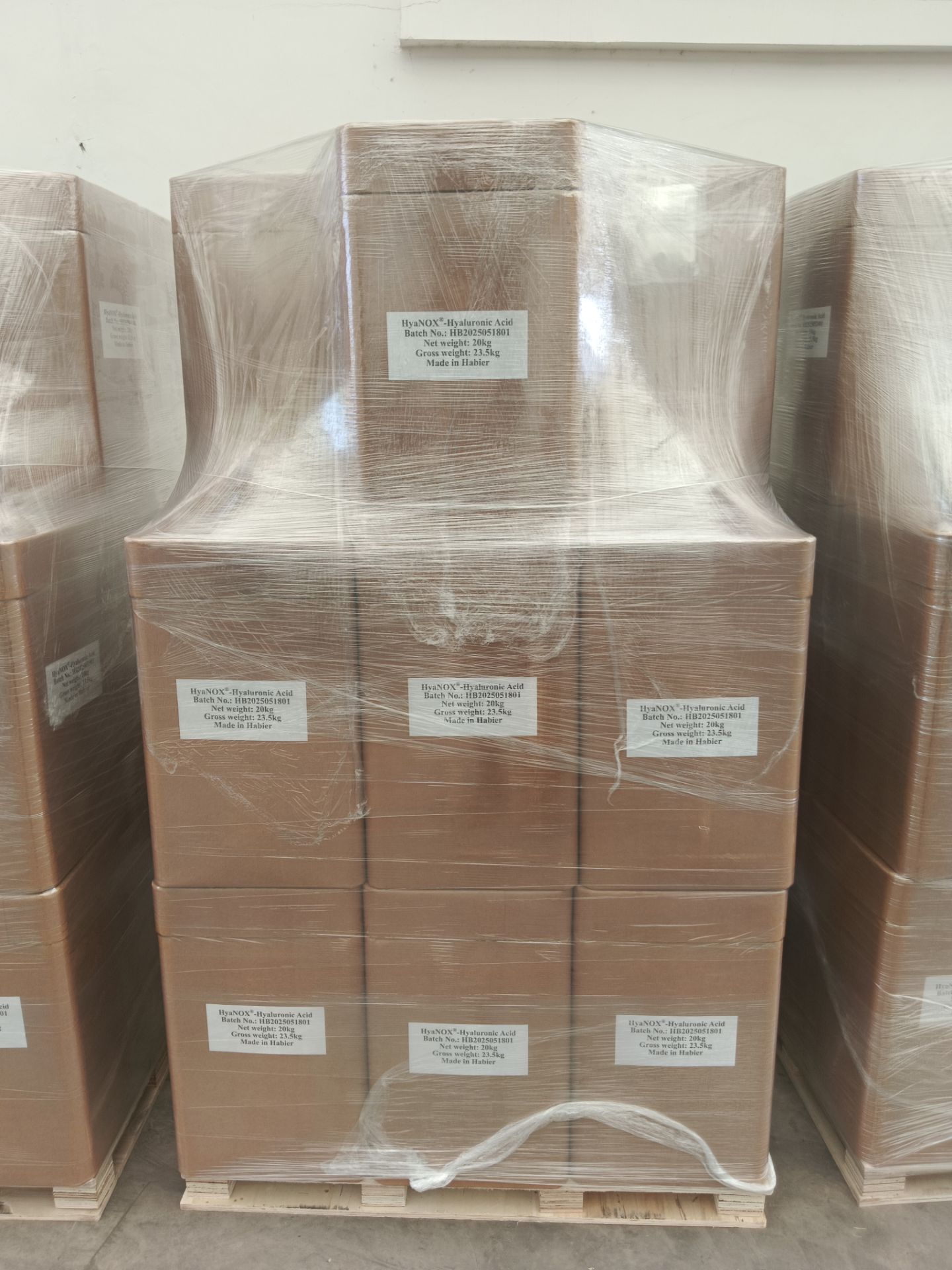
Problem Definition: Why Two Batches Labelled “Cosmetic Grade” Can Behave Differently
A grade name is a route marker, not a performance specification. “Cosmetic grade sodium hyaluronate” describes an intended use pathway and the documentation that should accompany it. It does not, by itself, tell a formulator whether the material in the drum is a high molecular weight polymer that builds a substantive film, or a low molecular weight fraction that disappears into a light essence without thickening it.
That gap is where formulation failures come from. Three problems recur:
- MW silence on the specification sheet. A purchase specification that lists only “cosmetic grade hyaluronic acid” leaves the molecular weight band open. Two compliant suppliers can ship materials that behave as different ingredients.
- Naming that hides the band. Hydrolyzed Sodium Hyaluronate, Ultra Low molecular weight sodium hyaluronate and Super Low molecular weight sodium hyaluronate all sit at the short-chain end of the family, while Regular grade sodium hyaluronate and High molecular weight sodium hyaluronate sit at the long-chain end. Buyers who treat these as synonyms inherit an unpredictable raw material.
- Misaligned documentation. A material can be functionally correct and still fail an inbound review if the certificate scope, the declared grade and the intended market do not line up. Compliance is checked against the product and its declared use, and that check has to start before the PO, not after the container arrives.
The practical consequence is simple: molecular weight should be written into the specification as a numeric band, next to the grade name, and it should be the first parameter a buyer negotiates.
Industry Background: A Raw Material Market Under Technical Scrutiny
Sodium hyaluronate demand is broad, but the technical demands placed on it are becoming narrower. Published market analysis puts the global sodium hyaluronate raw material market at approximately USD 504 million in 2024, driven by cosmetic and medical demand (Reports and Data). The food grade segment alone is estimated at USD 0.5 billion in 2024, with a projected CAGR of 8.5% through 2034 (Reports and Data).
Within the hyaluronic acid raw material market, the cosmetic grade segment held the largest share at 61.91% in 2025 (Grand View Research). In China, cosmetic ingredient filings in the first half of 2024 showed sodium hyaluronate remaining a top-tier classic ingredient for hydrating masks and essences (Plamed Group). Those numbers describe volume. They also explain why grade-level differentiation is now a competitive requirement rather than a marketing detail: when most of the market is cosmetic grade, the differentiator is the molecular weight band and the documentation behind it.
At the regulated end, the technical bar is explicit. Pharma grade sodium hyaluronate must meet USP-NF, European Pharmacopoeia (EP) and JP standards, with endotoxin levels typically below 0.05 EU/mg (Princeton Powder Guide). That is a specification conversation about impurities and monograph conformity, and it sits alongside — not instead of — the molecular weight conversation.
The competitive field is well documented: major global competitors in the sodium hyaluronate market include Bloomage Biotech, Fidia Farmaceutici, Kewpie Corporation and Contipro a.s. (Straits Research / Reports and Data). Buyers comparing these names should note that published market sizing is not directly comparable across sources — one dataset values the hyaluronic acid raw material market at USD 245.62 million, while another values sodium hyaluronate products at USD 14.02 billion, because one measures raw material and the other measures a much broader product definition. The lesson for procurement is to benchmark suppliers on specification and capability, not on market-size headlines.
The Molecular Weight Specification Map for Sodium Hyaluronate Grades
The Habier range is organised into five numeric bands. Each band answers a different formulation question, and each should be quoted as a range or a limit — never as a bare grade name.
Low Molecular Weight Grade — Max. 0.1 Million Da
The low MW band is the short-chain end of the range, and it is the band most often described with overlapping names: Low molecule weight sodium hyaluronate, Ultra Low molecule weight sodium hyaluronate, Super low molecule weight sodium hyaluronate, Hydrolyzed Sodium Hyaluronate, and the corresponding hyaluronic acid variants. In the Habier specification, the ceiling is Max. 0.1 Million Da.
Practically, short-chain material is chosen when the formulator wants the humectant function without the rheology. It contributes little thickening, so it is easier to build into low-viscosity formats — essences, light serums, toners and oral liquid formats — without disturbing the texture target. The trade-off is that a low MW fraction will not deliver the film-forming or cushioning behaviour of a long-chain polymer, so it should not be specified as a substitute for a high MW grade where a substantive feel or a viscosity build is the actual goal.
Food Grade Sodium Hyaluronate — 0.8–1.5 Million Da
Food grade sodium hyaluronate sits in the middle of the range at 0.8–1.5 Million Da. This is the band used for oral formats, including oral health care supplement raw material and oral care mass production. The mid-range position is a practical compromise: long enough to behave as a recognisable hyaluronate polymer in a finished oral product, and defined narrowly enough that batch-to-batch consistency can be verified against a COA.
For buyers, the key point is that “food grade” describes the safety and documentation pathway, while 0.8–1.5 Million Da describes the material. A purchase order should state both.
Cosmetic Grade Sodium Hyaluronate — 1.0–1.5 Million Da
Cosmetic grade sodium hyaluronate is specified at 1.0–1.5 Million Da. This band is the workhorse of skincare blending, where the material has to deliver moisture-binding performance while remaining predictable across blending, filling and storage. Habier’s product is certified as both COSMOS organic and ISO 16128, which is relevant for formulators building natural-origin claims around a cosmetic grade raw material.
Note the overlap with the food grade band and the difference in intent. Food grade runs 0.8–1.5 Million Da, cosmetic grade runs 1.0–1.5 Million Da. They are close, and that closeness is exactly why the grade declaration and its supporting documentation matter as much as the number itself.
High MW and Pharma Grade — Min. 2.0 Million Da
The long-chain end of the range is defined by a floor rather than a ceiling: High MW grade — Min. 2.0 Million Da and Pharma grade — Min. 2.0 Million Da. High molecular weight sodium hyaluronate is selected when viscosity, film formation and a substantive sensory profile are the design objectives.
Pharma grade shares the same minimum molecular weight threshold but adds a different compliance burden. Where the intended use is pharmaceutical, the material must be evaluated against USP-NF, EP and JP expectations, with endotoxin considerations typically expressed as below 0.05 EU/mg. A buyer working to a pharmacopoeial monograph should treat molecular weight as one line in a wider specification package, not the whole specification.
How Habier Supports Molecular Weight–Specific Sourcing
Selecting a molecular weight band is only useful if the supplier can hold it. Shandong Habier Biopharma Co., Ltd is a sodium hyaluronate manufacturer established on 14 May 2015 in Qufu City, Shandong Province, operating a 50,000 m² factory with 123 employees, an annual output of 600–700 MT, an R&D team of 6 engineers, and an export ratio of 20% serving the EU, USA and Korea markets.
On the production side, the operating parameters that matter most for multi-grade sourcing are:
- OEM and ODM services — both Original Equipment Manufacturing and Original Design Manufacturing are offered.
- Customization: purity adjustment — the material can be adjusted to a defined purity specification rather than supplied as a fixed, untunable grade.
- Monthly production capacity of 50–60 tons, with a typical lead time of 5–8 days and a minimum order quantity of 1 kg.
- 100% full inspection before delivery, with free sample supply and after-sales quality tracking.
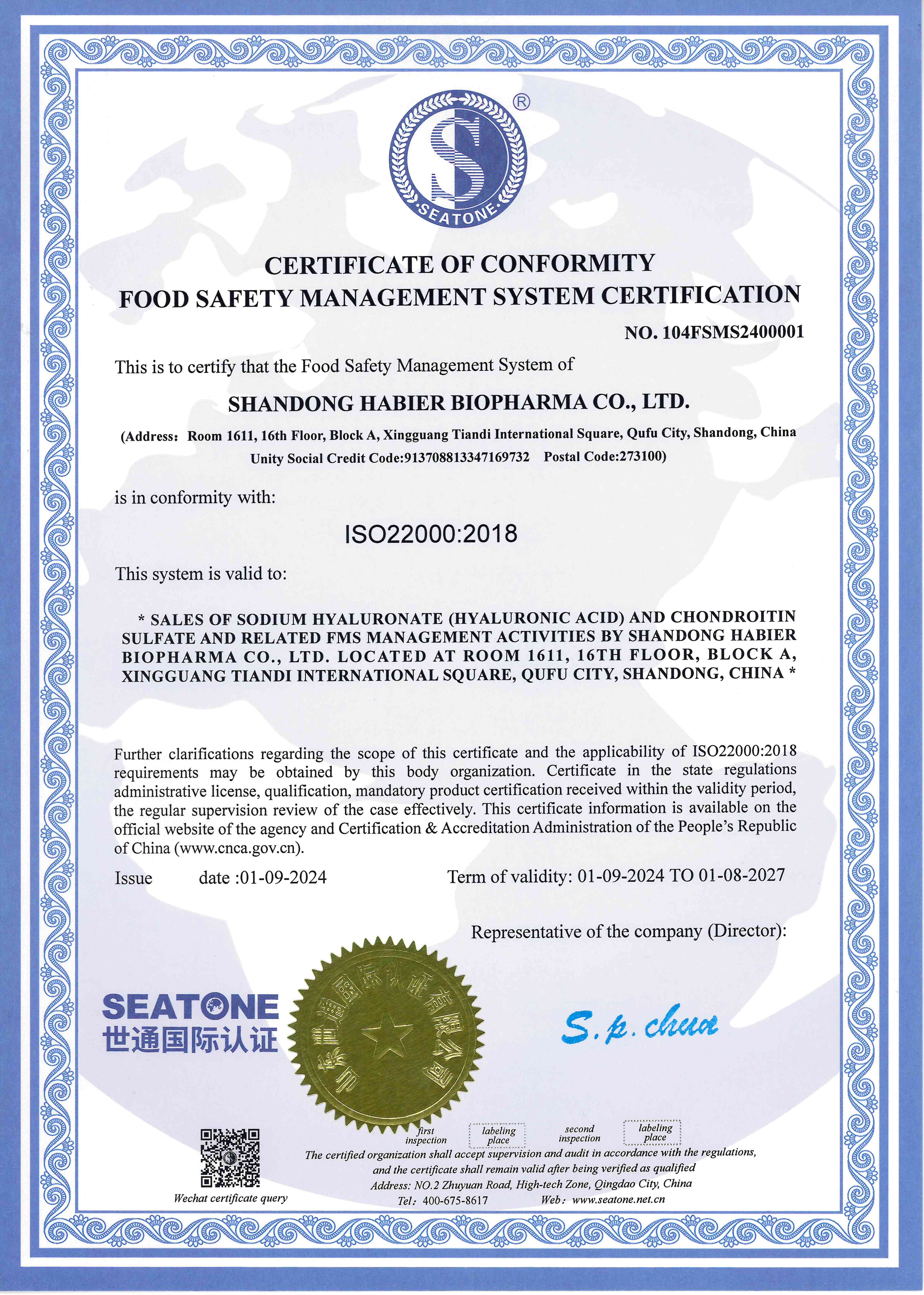
On documentation, the company’s qualification system is built on dual ISO certification plus HACCP, Kosher and Halal. Two certificates are worth naming in full because buyers will need the numbers: ISO 22000:2018 food safety management system certification, certificate no. 104FSMS2400001, covering the sales of sodium hyaluronate (hyaluronic acid) and chondroitin sulfate and related food safety management activities; and ISO 9001:2015 quality management system certification, certificate no. 1042Q00053R0S, with scope recorded as ALL. Both were issued on 1 September 2024 by Shandong Seatone International Certification Co., Ltd. and are valid to 8 January 2027.

Step-by-Step: Specifying a Sodium Hyaluronate Molecular Weight Grade Before You Order
The following sequence is designed to be used by a formulator and a procurement specialist together. It converts a formulation target into a purchase specification that can be verified on receipt.
Step 1 — Define the function, not the ingredient. State whether the material must thicken, film, cushion, hydrate without thickening, or simply be present as a declared active in an oral format. Viscosity-building and film-forming functions point to the high MW end; hydration without texture impact points to the low MW end.
Step 2 — Convert the function into a numeric MW band. Use the Habier map: Max. 0.1 Million Da for low MW and hydrolyzed specifications; 0.8–1.5 Million Da for food grade; 1.0–1.5 Million Da for cosmetic grade; Min. 2.0 Million Da for high MW and pharma grade. Write the band — with its limit or range — directly into the specification.
Step 3 — Fix the naming convention. Decide whether the specification will read “sodium hyaluronate”, “hyaluronic acid” or “hyaluronic acid sodium salt”, and whether the short-chain material is to be described as Hydrolyzed, Ultra Low or Super Low molecular weight. Inconsistent naming is a common source of receiving disputes.
Step 4 — Match the grade pathway to the certificate scope. Confirm that the certificate covering your intended market and use is current. For food-related applications, the ISO 22000 certificate scope relates to the sales of sodium hyaluronate (hyaluronic acid) and related food safety management activities; ISO 9001 covers the quality management system across the operation. Check expiry dates — both certificates run to 8 January 2027.
Step 5 — Confirm customization and purity requirements. If the application needs an adjusted purity profile rather than a catalogue grade, confirm it as a customization item. This is where purity adjustment as a defined Habier capability becomes a specification line rather than a request.
Step 6 — Validate with a sample in your own formulation. Molecular weight behaviour is formulation-specific. Free sample supply and after-sales quality tracking exist precisely so that a 1.0–1.5 Million Da cosmetic grade or a Max. 0.1 Million Da low MW material can be trialled under your own process conditions before scale-up.
Step 7 — Lock the commercial frame. Confirm MOQ (1 kg), delivery terms (FOB/CIF), inspection arrangements, and lead time (typically 5–8 days) against your production calendar, then agree the batch documentation package, including a pre-shipment full test with a COA report.
Use Cases: Matching Molecular Weight Bands to Real Applications
1. Cosmetic skincare blending
A blending project typically needs two behaviours from one raw material family. A high MW or cosmetic grade material at 1.0–1.5 Million Da contributes body and film; a low MW or hydrolyzed material at Max. 0.1 Million Da contributes hydration without disturbing the texture. Specifying both bands in one program is a normal arrangement where the supplier runs OEM and ODM production with purity adjustment and a 1 kg MOQ.
2. Oral health care supplements
Oral formats are specified in the food grade band at 0.8–1.5 Million Da. The requirement here is less about rheology and more about consistency and documentation, because the material becomes part of a consumer product with a declared ingredient list.
3. Pharmaceutical specification pathways
Where the route is pharmaceutical, the specification starts at Min. 2.0 Million Da and then expands to pharmacopoeial conformity. Buyers should expect to work against USP-NF, EP or JP expectations and to discuss endotoxin limits, typically expressed as below 0.05 EU/mg, alongside molecular weight.
4. Case: 4,733 kg supplied to a US cosmetic and supplement importer
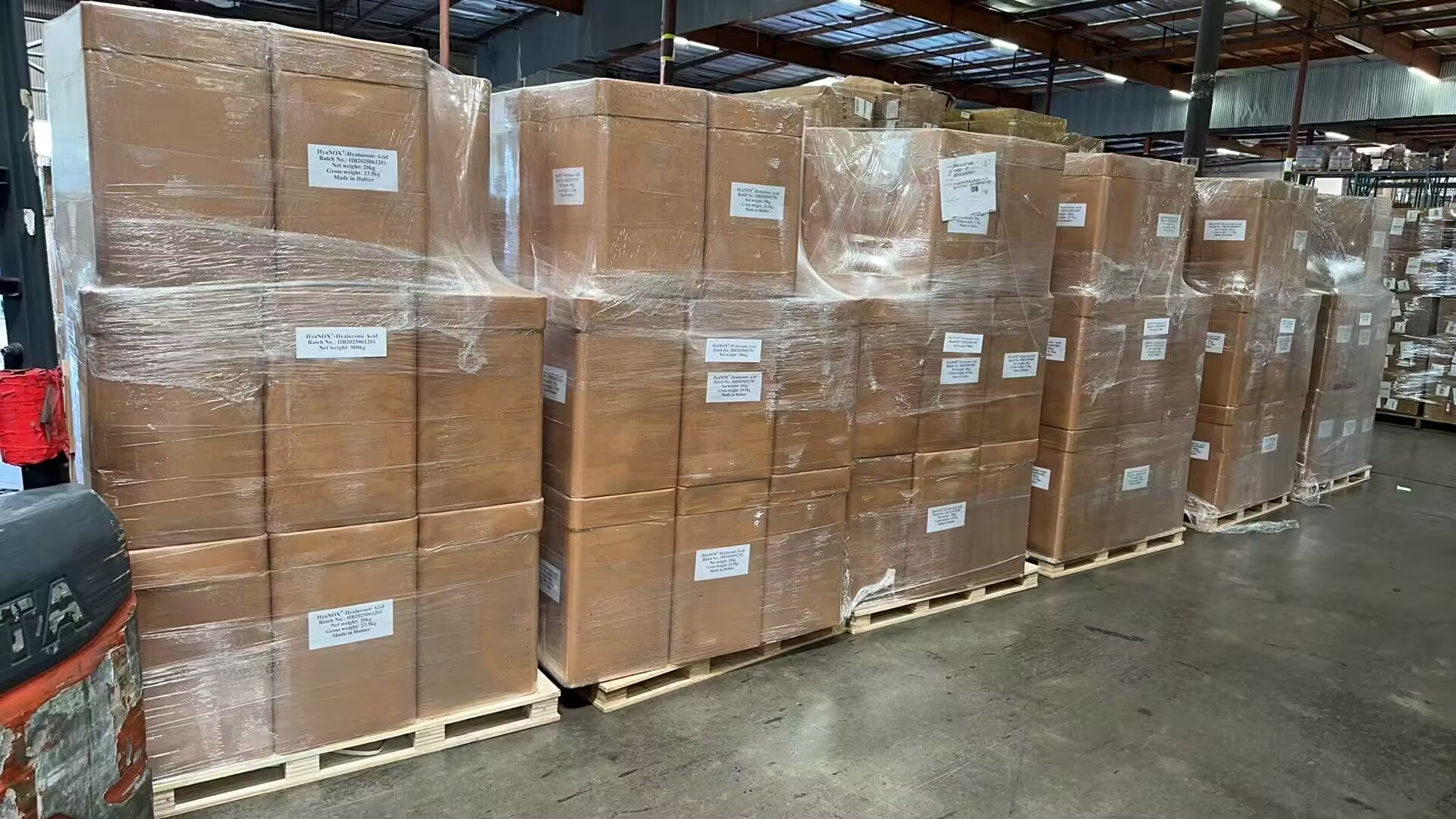
A natural cosmetic and health supplement importer in the United States has taken 4,733 kg of avian-origin hyaluronic acid raw material for cosmetic raw material and oral health care supplement raw material applications on a long-term, repeat-order basis. The material carries complete official veterinary heat treatment certification and meets US APHIS import standards, with customs clearance supported by a valid USDA import permit. The reported outcome is stable supply of high-purity hyaluronic acid raw material covering laboratory, cosmetic and oral care mass production demand, with stable batch quality across repeat orders.
The case is relevant to a molecular weight discussion because it shows what “grade” has to deliver in practice on a regulated import route: the declared specification, the origin documentation and the import certification have to agree with one another, batch after batch.

Sodium Hyaluronate Grade and Molecular Weight Comparison
The table below consolidates the specification bands used in this guide. All molecular weight values are the declared Habier specification parameters; the compliance anchors are the certifications and standards named above.
| Grade / specification | Molecular weight band | Primary application pathway | Compliance anchor |
|---|---|---|---|
| Low MW grade, incl. Hydrolyzed / Ultra Low / Super Low molecular weight sodium hyaluronate | Max. 0.1 Million Da | Hydration without viscosity build; light cosmetic formats; liquid oral formats | Covered by the manufacturer’s ISO 9001:2015 quality management system (no. 1042Q00053R0S, valid to 8 January 2027) |
| Food grade sodium hyaluronate / food grade hyaluronic acid | 0.8–1.5 Million Da | Oral health care supplement raw material and oral care production | ISO 22000:2018 food safety management system (no. 104FSMS2400001, valid to 8 January 2027) |
| Cosmetic grade sodium hyaluronate / cosmetic grade hyaluronic acid | 1.0–1.5 Million Da | Cosmetic raw material and skincare blending | COSMOS organic and ISO 16128 product certification; ISO 9001:2015 quality management system |
| High MW grade / High molecular weight sodium hyaluronate | Min. 2.0 Million Da | Viscosity build, film formation, substantive sensory profile | ISO 9001:2015 quality management system (scope: ALL) |
| Pharma grade sodium hyaluronate / pharma grade hyaluronic acid | Min. 2.0 Million Da | Pharmaceutical specification pathway | USP-NF, EP and JP standards, with endotoxin typically below 0.05 EU/mg (Princeton Powder Guide) |
Note: the manufacturer’s qualification system also includes HACCP, Kosher and Halal. Certificate numbers should always be verified against the current certificate copy for your destination market.
FAQ
Does molecular weight affect which certifications a sodium hyaluronate grade can carry?
Certification attaches to the product, the manufacturing site and the declared scope — not to a molecular weight number on its own. Habier holds ISO 22000:2018 food safety management system certification (no. 104FSMS2400001) covering the sales of sodium hyaluronate (hyaluronic acid) and related food safety management activities, and ISO 9001:2015 quality management system certification (no. 1042Q00053R0S) with the scope recorded as ALL. Both were issued on 1 September 2024 by Shandong Seatone International Certification Co., Ltd. and remain valid to 8 January 2027. The qualification system also includes HACCP, Kosher and Halal, and the product is certified as both COSMOS organic and ISO 16128. When you select a food grade (0.8–1.5 Million Da) or cosmetic grade (1.0–1.5 Million Da) band, confirm the certificate scope matches your intended use and market; for a pharma grade specification at Min. 2.0 Million Da, request the batch documentation relevant to the pharmacopoeial monograph you are working to.
Can one supplier deliver several molecular weight grades within a single program?
Yes, provided the supplier runs both OEM and ODM production and can adjust purity to a defined specification. Habier provides OEM (Original Equipment Manufacturing) and ODM (Original Design Manufacturing) services with a minimum order quantity of 1 kg, a typical lead time of 5–8 days, and a monthly production capacity of 50–60 tons, and every shipment is subject to 100% full inspection before delivery. That combination matters when one cosmetic project needs a 1.0–1.5 Million Da cosmetic grade sodium hyaluronate alongside a Max. 0.1 Million Da low molecular weight or hydrolyzed material, while an oral project runs on food grade at 0.8–1.5 Million Da.
How should procurement compare cost across different molecular weight grades?
Sodium hyaluronate is not priced from a public list, and Habier does not publish unit prices; commercial terms are project-specific. What is defined publicly is the commercial structure around an order: MOQ 1 kg, FOB/CIF delivery terms, pre-shipment full testing with a COA report, support for third-party lab inspection, and on-site factory inspection. Payment is mainly a high advance payment mode, with large long-term clients able to negotiate separately. When comparing quotations across MW bands, compare the cost of the band you actually need, the order quantity, the inspection and documentation package, and the delivery terms together — a lower headline figure for a grade that does not match your target function is the most expensive option in the set.
Are samples available for both low and high molecular weight grades?
Free sample supply is part of Habier’s after-sales service, alongside after-sales quality tracking. Sample validation is the practical way to confirm molecular weight behaviour, because MW performance is formulation-specific: a food grade material at 0.8–1.5 Million Da, a cosmetic grade material at 1.0–1.5 Million Da, a high MW or pharma grade material at Min. 2.0 Million Da, and a low MW material at Max. 0.1 Million Da will each respond differently to your blending, heating and filling conditions. Testing in your own formulation before scale-up is the step that converts a numeric specification into a reliable production input.
What is the lead time and order size for a multi-grade sodium hyaluronate order?
Typical production lead time is 5–8 days, the minimum order quantity is 1 kg, and monthly production capacity is 50–60 tons. For a program that combines several molecular weight bands, the practical approach is to confirm the full band list, the customization and purity requirements, and the documentation package in one specification, then schedule the first shipment against your production calendar. To request a sample, a quotation or the full product catalogue, contact Jake Chen at jake@habier.com or +86-186-0537-0487, or review the product range at www.habier.com.
Conclusion: Write the Number, Then Verify the Batch
Molecular weight is the parameter that turns a sodium hyaluronate grade name into a usable specification. Low MW material at Max. 0.1 Million Da serves hydration-led formats; food grade at 0.8–1.5 Million Da serves oral and supplement applications; cosmetic grade at 1.0–1.5 Million Da serves skincare blending; high MW and pharma grade at Min. 2.0 Million Da serve viscosity, film-forming and pharmacopoeial pathways. The grade tells you the route. The number tells you the behaviour.
For formulators and procurement specialists working with Shandong Habier Biopharma Co., Ltd, the operating facts that make that specification holdable are a 50,000 m² facility, 600–700 MT annual output, OEM and ODM production with purity adjustment, a 1 kg MOQ, a 5–8 day typical lead time, 50–60 tons monthly capacity, 100% full inspection before delivery, and current ISO 22000:2018 and ISO 9001:2015 certification valid to 8 January 2027.
Next step: if you are ready to specify a molecular weight band rather than a grade name, request a free sample for formulation trials, ask for a quotation on your target band, or download the full product brochure for the complete specification list.
Download the brochure: Habier Biopharma product brochure (PDF)
Contact: Jake Chen | Email: jake@habier.com | Tel: +86-186-0537-0487 | Add: 16F Building A Xingguangtiandi International Square, Qufu City, Shandong, China 273100 | Website: www.habier.com
Have Questions or Need More Details?
Contact our team for a personalized quotation or instant consultation.
Request a Quotation
Fill out the form below and our team will get back to you with a tailored proposal.
WhatsApp Direct Chat
Prefer to chat in real-time? Message us on WhatsApp for instant assistance & quick answers.
- Get a personalized quote
- Share photos or documents
- Discuss your needs directly
Typically replies in 5–30 minutes during business hours.