
Audit-Ready Sodium Hyaluronate: ISO 9001, ISO 22000, Kosher, Halal & COSMOS
Audit-Ready Sodium Hyaluronate: ISO 9001, ISO 22000, Kosher, Halal & COSMOS
Buyers who move from shortlisting a sodium hyaluronate supplier to actually releasing a purchase order usually hit the same wall: everybody claims to be certified, yet very few suppliers can hand over a certificate whose scope, number and expiry date match the material on the purchase order. This guide unpacks the compliance documents held for sodium hyaluronate product code 5243 at Shandong Habier Biopharma Co.,LTD — a sodium hyaluronate manufacturer established on 14 May 2015 in Qufu City, Shandong Province, China — and explains what each document proves, what it does not prove, and where regional requirements add a second layer of paperwork.
It is written for the execution stage rather than the discovery stage. That means fewer explanations of what hyaluronic acid is, and more attention to the four questions a compliance or procurement reviewer actually asks: which certificate, issued by whom, valid until when, and does the scope name sodium hyaluronate.
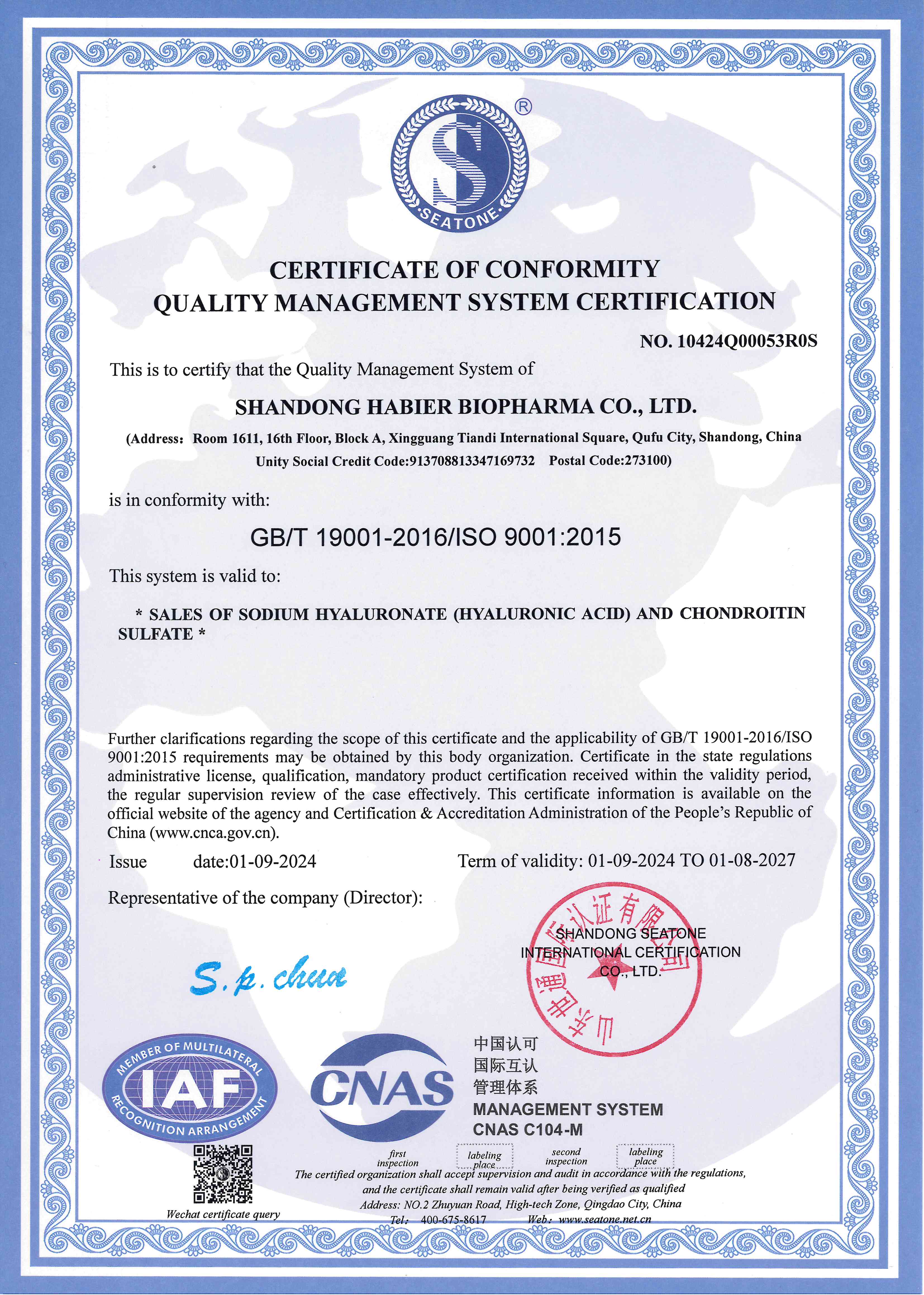
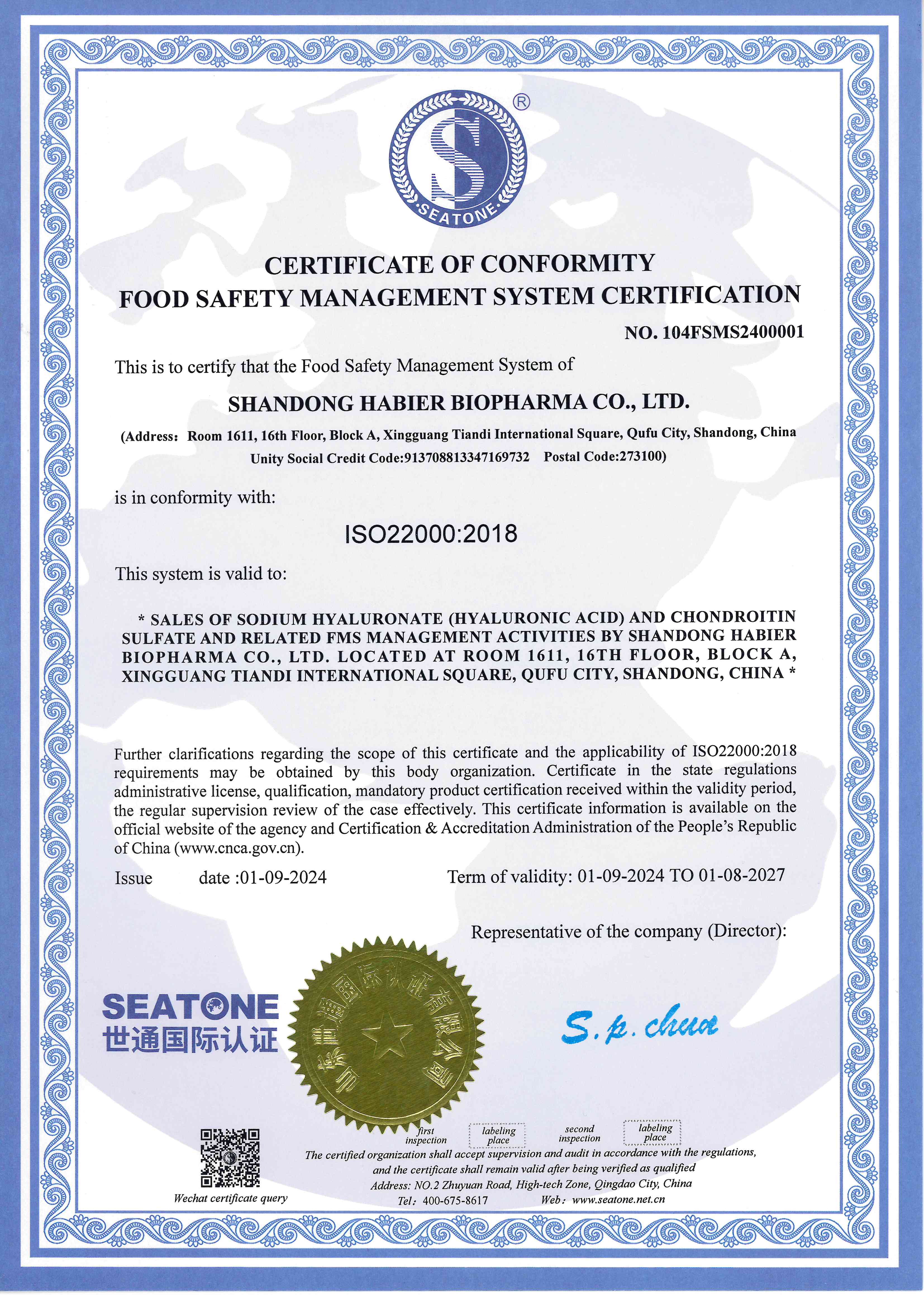
Short answer: Sodium hyaluronate under product code 5243 is covered by two third-party management-system certificates — ISO 9001:2015, certificate no. 1042Q00053R0S and ISO 22000:2018, certificate no. 104FSMS2400001 — both issued by SHANDONG SEATONE INTERNATIONAL CERTIFICATION CO.,LTD. on 1 September 2024 and both valid until 8 January 2027. The company qualification system additionally includes HACCP, Kosher and Halal, and the product carries COSMOS organic and ISO 16128 certification. For US-bound animal-origin material, a third layer applies: official veterinary heat treatment certification meeting US APHIS import standards.
The Compliance Gap Buyers Hit Between Evaluation and Execution
The word "certified" is doing far too much work in most sodium hyaluronate quotations. In practice it bundles together three completely different things: a management-system certificate issued to the company, a batch-level quality document issued to a specific lot, and a market-access permit issued by a destination-country authority. A supplier can hold the first, produce the second on demand, and still be unable to ship to a specific market because the third was never requested before.
Four failure patterns account for most compliance delays in this category:
- Scope mismatch. The certificate is genuine, but nothing in its scope mentions sodium hyaluronate, food safety, or the activity being audited.
- Expired documents in circulation. Buyers receive a scanned copy that was valid two renewal cycles ago and never check the expiry date.
- System certificate mistaken for batch evidence. A quality management system certificate says the process is controlled; it does not say what is inside the drum you are about to receive. That is the job of pre-shipment testing and a COA report.
- Missing regional add-ons. Animal-origin material is the classic case — the certificate set is complete, but the destination market wants a veterinary document that was never generated.
The practical lesson is simple: compliance verification should be organised around documents, not around claims. Every item in this guide is therefore tied to a document number, an issuing body, a validity window, or a named shipment.
Why Sodium Hyaluronate Carries Two Different Kinds of Compliance Burden
Sodium hyaluronate sits across food, cosmetic and pharmaceutical applications, and the compliance expectations follow the application rather than the molecule. That is the first structural reason the paperwork looks heavier than it does for a single-use ingredient.
The second reason is the production route. A peer-reviewed review of industrial hyaluronic acid production describes two routes: extraction from animal tissues, or large-scale bacterial fermentation using genetically modified strains. Fermentation dominates commercial supply and has been studied across batch, repeated batch, fed-batch and continuous modes, with reported yields in the range of 2.5–7.0 g/L in the reviewed literature. But extraction-derived and animal-origin material still circulate in specific supply chains, and when it does, the document set changes: origin statements and official veterinary heat treatment certification enter the file, and destination-market rules such as US APHIS import standards become the binding constraint.

A third layer is regulatory rather than commercial. In China, the National Medical Products Administration stated in Announcement No. 103 of 2022 that medical sodium hyaluronate products which contain no pharmacologically, metabolically or immunologically active drug ingredients are managed as medical devices, and that the management category must be no lower than Class II in the described cases. That classification governs the registration pathway for finished medical products; it is not satisfied by a raw-material supplier's ISO 22000 certificate. Buyers sourcing pharma or medical grade material should treat supplier certification and product registration as two separate workstreams.
Market scale explains why this documentation discipline matters commercially. Fortune Business Insights puts the global hyaluronic acid market at USD 11.64 billion in 2025, with a projected USD 22.36 billion by 2034 and a 7.52% CAGR across 2026–2034. As volumes grow, so does the frequency of audits — and an audit is where document quality, not product quality, decides the outcome.
The Certification Stack for Product Code 5243, Document by Document
ISO 9001:2015 — Quality Management System, No. 1042Q00053R0S
The quality management system certificate is registered under the standard GB/T 19001-2016 / ISO 9001:2015, certificate number 1042Q00053R0S, issued by SHANDONG SEATONE INTERNATIONAL CERTIFICATION CO.,LTD. The issue date is 1 September 2024 and the expiry date is 8 January 2027. The certificate's scope field is recorded as "ALL", and the related product listed against it is product code 5243 — Sodium Hyaluronate, covering food grade, cosmetic grade, pharma grade, high molecule weight grade and low molecule weight grade.
What this document gives a buyer is process assurance: documented control over how the material is produced, released and handled before dispatch. Because the scope is recorded broadly rather than as a narrow activity statement, the practical verification step shifts to the audit report and to on-site inspection — which is why on-site factory inspection is offered as part of the acceptance process rather than as a special favour.
ISO 22000:2018 — Food Safety Management System, No. 104FSMS2400001
The food safety certificate is registered under ISO 22000:2018, certificate number 104FSMS2400001, from the same certification body, with the same issue date of 1 September 2024 and the same expiry date of 8 January 2027. Its scope is stated specifically as Sales of Sodium Hyaluronate (Hyaluronic Acid) and Chondroitin Sulfate and related food safety management activities.
For a buyer, this is the more informative of the two certificates, because the scope literally names the material. When a supplement brand or a food importer asks whether the supplier's food safety processes have been third-party audited for sodium hyaluronate specifically, this certificate answers the question with a document rather than a reassurance. It also pairs naturally with the HACCP element of the company's qualification system.
HACCP, Kosher and Halal — the Qualification Layer
Beyond the two ISO certificates, the company's qualification system includes HACCP, Kosher and Halal. These serve different purposes and should not be filed together.
- HACCP addresses hazard analysis and critical control points in food handling — it complements ISO 22000 rather than duplicating it, and buyers reviewing a food or supplement application typically ask for both.
- Kosher and Halal are market-access marks. They matter when the finished product will be sold into markets or to consumer segments where those certifications are a purchase condition, and they are checked at ingredient level, not at brand level.
Because these are qualification-system marks rather than numbered certificates in the compliance record above, the buyer's action is straightforward: request the current copies in force, confirm the validity date on each, and confirm that the certified entity name matches the entity issuing the commercial invoice.
COSMOS Organic and ISO 16128 — Product-Level Cosmetic Claims
For cosmetic applications, product 5243 is certified as both COSMOS organic and ISO 16128. This is a product-level certification, not a plant-level one, and that distinction matters: a cosmetics brand that intends to print a natural-origin or organic-content claim on pack needs ingredient-level support, and a general company certificate will not survive a claims review.
ISO 16128 is the ISO standard series for natural and organic cosmetic ingredients, and COSMOS is the organic cosmetics certification scheme. Together they give a formulator a defensible basis for calculating and substantiating natural-origin content, subject to the brand's own claims review. Buyers should request the product-level certificate itself, not a summary line in a brochure.
The Regional Layer — US APHIS and the USDA Import Permit
Certification does not travel automatically across borders. A documented example makes the point. A natural cosmetic and health supplement importer in the United States received 4,733 kg of hyaluronic acid raw material intended for cosmetic raw material and oral health care supplement raw material use, on a long-term stable basis. The material was avian-origin and was accompanied by complete official veterinary heat treatment certification, meeting US APHIS import standards; customs clearance was supported by a valid USDA import permit.
Note what did the work here. Neither ISO certificate would have secured that clearance. The decisive documents were the origin-linked veterinary heat treatment certificate and the import permit. This is exactly the gap described earlier: a supplier can be fully certified and still fail a US shipment if the animal-origin documentation chain is incomplete.
What Keeps the Certificates Valid
Both certificates run from 1 September 2024 to 8 January 2027. ISO management-system certificates are not permanent documents: within that window they remain valid only while the certification body's scheduled surveillance activity is maintained, and renewal is required before expiry. That has a direct procurement consequence. A buyer signing a multi-year supply agreement in 2026 is signing against a certificate set that reaches its expiry date in January 2027, so the contract should include a clause requiring updated certificates to be provided as they are renewed, and the qualification file should carry a review reminder ahead of that date.
Annual or periodic third-party re-verification is what converts a one-time certificate into continuous market access — it is the mechanism that keeps the scope, the site and the process aligned as production volumes, product grades and customer requirements change.
Six Verification Steps Before You Release a Purchase Order
- Match the scope to your use case. Read the scope field, not the certificate title. For food and supplement use, the ISO 22000:2018 scope that names sales of sodium hyaluronate is the relevant reference. For general supply assurance, the ISO 9001:2015 certificate with the scope recorded as "ALL" applies.
- Verify number, issuer and dates. Record certificate no. 1042Q00053R0S and no. 104FSMS2400001 against the issuer, SHANDONG SEATONE INTERNATIONAL CERTIFICATION CO.,LTD., and note the expiry date of 8 January 2027 in your supplier file.
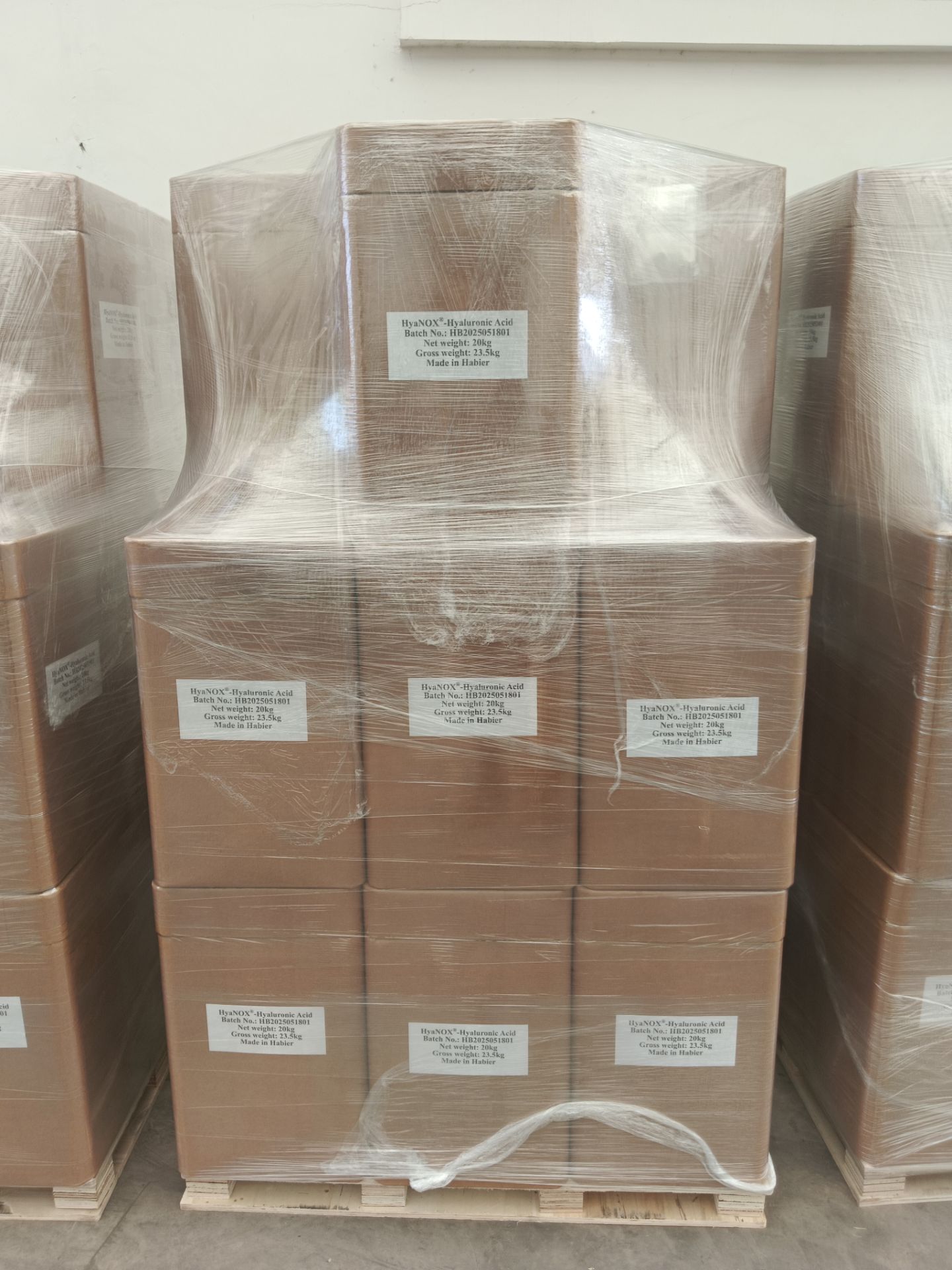
- Ask for batch-level evidence. Certification does not describe the drum in front of you. The acceptance route is a pre-shipment full test with a COA report; third-party laboratory inspection is supported, and on-site factory inspection can be arranged.
- Confirm destination-market add-ons. If the material is animal-origin and bound for the United States, confirm the official veterinary heat treatment certification against US APHIS import standards and the validity of the USDA import permit before booking freight.
- Check the claim documents your brand will print. COSMOS organic and ISO 16128 are product-level certifications for cosmetic claims; Kosher and Halal copies must be the versions currently in force. Collect these before the marketing team finalises artwork.
- Lock the commercial terms that protect the timeline. The minimum order quantity is 1 kg, typical lead time is 5–8 days, and monthly production capacity is 50–60 tons. Delivery terms are FOB or CIF. Payment is mainly structured on a high advance payment basis, with separate negotiation available for large long-term clients. Release the order only once the document set and the delivery window are both confirmed in writing.
Four Buyer Profiles and the Document Each One Actually Needs
US cosmetic and supplement importer. The binding documents are the veterinary heat treatment certificate and the USDA import permit for animal-origin material, supported by the ISO 22000:2018 food safety certificate and pre-shipment COA. This is the profile behind the 4,733 kg case, where the material served both cosmetic raw material and oral health care supplement raw material uses on a long-term repeat basis.
EU cosmetic brand. The product-level COSMOS organic and ISO 16128 certifications carry the most weight, because they support the natural-origin and organic claims that appear on pack. The ISO 9001:2015 quality management certificate supports the supplier qualification file, and full-item batch inspection before delivery supports incoming goods release.
Food and dietary supplement brand entering Kosher or Halal markets. Here the qualification layer does the work: Kosher and Halal marks, HACCP, and the ISO 22000:2018 certificate whose scope names sodium hyaluronate sales and related food safety management activities. Missing any one of these can stop a listing regardless of product quality.
OEM or ODM brand owner scaling a formulation. Both OEM (Original Equipment Manufacturing) and ODM (Original Design Manufacturing) services are available, with purity adjustment offered as the customisation route. A 1 kg minimum order quantity makes pilot batches practical, and the 5–8 day typical lead time supports iterative development. For this profile, the certificates establish the supplier; the flexibility establishes the fit.
Certification and Document Matrix
| Certification / mark | Standard and reference number | Issued by | Valid until | What it covers |
|---|---|---|---|---|
| ISO 9001 | GB/T 19001-2016 / ISO 9001:2015, no. 1042Q00053R0S | SHANDONG SEATONE INTERNATIONAL CERTIFICATION CO.,LTD. | 8 January 2027 | Quality management system; scope recorded as "ALL"; issued 1 September 2024 |
| ISO 22000 | ISO 22000:2018, no. 104FSMS2400001 | SHANDONG SEATONE INTERNATIONAL CERTIFICATION CO.,LTD. | 8 January 2027 | Sales of sodium hyaluronate (hyaluronic acid) and chondroitin sulfate and related food safety management activities; issued 1 September 2024 |
| HACCP | Part of the company qualification system | — | Confirm current copy | Food safety hazard control, complementary to ISO 22000 |
| Kosher | Part of the company qualification system | — | Confirm current copy | Market access for kosher-certified applications |
| Halal | Part of the company qualification system | — | Confirm current copy | Market access for halal-certified applications |
| COSMOS organic | Product-level certification | — | Confirm current copy | Organic cosmetic claim support for product 5243 |
| ISO 16128 | Product-level certification | — | Confirm current copy | Natural-origin content basis for cosmetic formulations |
| Document | Issued when | Question it answers |
|---|---|---|
| ISO 9001:2015 certificate | Issued 1 September 2024, valid to 8 January 2027 | Is the supplier's quality system third-party certified? |
| ISO 22000:2018 certificate | Issued 1 September 2024, valid to 8 January 2027 | Has the food safety system for sodium hyaluronate sales been third-party audited? |
| Pre-shipment COA report | Per batch, before dispatch | Does this specific lot meet specification? |
| Third-party laboratory report | On request; third-party inspection supported | Does an independent lab confirm the result? |
| Veterinary heat treatment certificate | Supplied with animal-origin material | Does the material meet US APHIS import standards? |
| USDA import permit | Per import consignment | Is the shipment cleared to enter the United States? |
Frequently Asked Questions
Which certifications apply specifically to sodium hyaluronate product code 5243, and who issued them?
Product code 5243 is covered by ISO 9001:2015 certificate no. 1042Q00053R0S and ISO 22000:2018 certificate no. 104FSMS2400001, both issued by SHANDONG SEATONE INTERNATIONAL CERTIFICATION CO.,LTD. on 1 September 2024 and both valid until 8 January 2027. The ISO 22000 scope explicitly covers sales of sodium hyaluronate (hyaluronic acid) and related food safety management activities. The company qualification system further includes HACCP, Kosher and Halal, and the product holds COSMOS organic and ISO 16128 certification.
What documentation is required for animal-origin sodium hyaluronate shipped to the United States?
Animal-origin material requires more than an ISO certificate. In a documented case, 4,733 kg of avian-origin hyaluronic acid raw material was supplied with complete official veterinary heat treatment certification meeting US APHIS import standards, and customs clearance was supported by a valid USDA import permit. The material was used for cosmetic raw material and oral health care supplement raw material applications by a natural cosmetic and health supplement importer. Buyers should confirm both the veterinary document and the import permit before freight is booked.
Can certified sodium hyaluronate supply support OEM and ODM volumes?
Yes. Both OEM (Original Equipment Manufacturing) and ODM (Original Design Manufacturing) services are available, with purity adjustment as the customisation option. Monthly production capacity is 50–60 tons, the minimum order quantity is 1 kg, and typical production lead time is 5–8 days. Every delivery is subject to 100% full inspection before dispatch, which is what connects the certified process to the individual batch.
What are the commercial and acceptance terms to budget for?
The minimum order quantity is 1 kg and delivery terms are FOB or CIF. Payment is mainly structured on a high advance payment basis, with separate terms negotiable for large long-term clients. Acceptance criteria are a pre-shipment full test with a COA report, supported third-party laboratory inspection, and the option of on-site factory inspection. Budgeting should also account for any destination-market documentation, since that cost sits outside the material price.
Can I obtain a sample, and how quickly can a first order ship?
Free sample supply is available, and after-sales quality tracking continues after delivery. Typical production lead time is 5–8 days, so the timeline is driven mainly by how fast the specification and destination documentation are agreed rather than by manufacturing. To start a sample or quotation request, contact Jake Chen at jake@habier.com or +86-186-0537-0487, or review the technical range in the product brochure.
Conclusion: Compliance Is a Document Trail, Not a Claim
Sodium hyaluronate compliance is settled by four pieces of information per document — the certificate number, the issuing body, the scope wording, and the expiry date — followed by one question about the destination market. For product code 5243, that trail runs from ISO 9001:2015 no. 1042Q00053R0S and ISO 22000:2018 no. 104FSMS2400001, issued by SHANDONG SEATONE INTERNATIONAL CERTIFICATION CO.,LTD. and valid to 8 January 2027, through the HACCP, Kosher and Halal elements of the qualification system and the product-level COSMOS organic and ISO 16128 certifications, and ends at the regional layer, where avian-origin material bound for the United States needs official veterinary heat treatment certification meeting US APHIS import standards and a valid USDA import permit.
Shandong Habier Biopharma Co.,LTD is a sodium hyaluronate manufacturer established on 14 May 2015, operating a 50,000 m² facility in Qufu City, Shandong Province, China, with 600–700 MT annual output and main markets in the EU, USA and Korea. Buyers at the execution stage can verify the certificate set, request batch documentation, arrange on-site inspection, and then move to a commercial decision that is defensible in front of their own quality team.
Request a sample and the current certificate pack
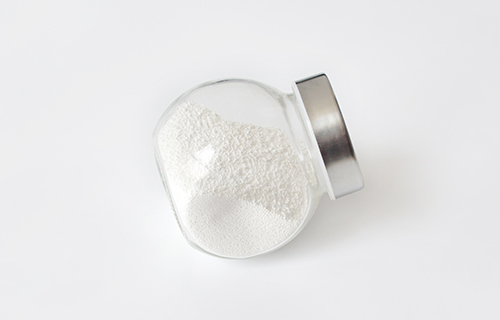
Samples are supplied free of charge. Request the certificate copies currently in force — ISO 9001:2015, ISO 22000:2018, HACCP, Kosher, Halal, COSMOS organic and ISO 16128 — together with a COA for the grade you intend to qualify.
Contact: Jake Chen · jake@habier.com · +86-186-0537-0487
Address: 16F Building A Xingguangtiandi International Square, Qufu City, Shandong, China 273100
Website: www.habier.com · Download the product brochure (PDF)
This article describes the certification documents held for sodium hyaluronate product code 5243 as recorded in the company compliance file. Buyers should always verify the certificate copies currently in force and confirm the regulatory requirements of their own destination market before shipment.
Have Questions or Need More Details?
Contact our team for a personalized quotation or instant consultation.
Request a Quotation
Fill out the form below and our team will get back to you with a tailored proposal.
WhatsApp Direct Chat
Prefer to chat in real-time? Message us on WhatsApp for instant assistance & quick answers.
- Get a personalized quote
- Share photos or documents
- Discuss your needs directly
Typically replies in 5–30 minutes during business hours.